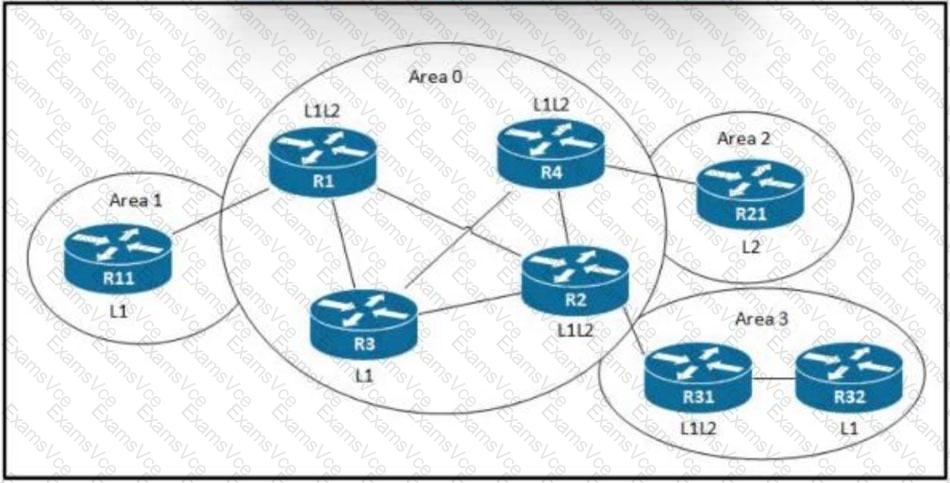
R3 must be made an L1/L2 router so that it can connect the Level 1 area to the Level 2 backbone. IS-IS uses a two-level hierarchy. Level 1 routers know the topology inside their local area, Level 2 routers form the backbone between areas, and Level 1/Level 2 routers provide the boundary between the two. A proper IS-IS backbone cannot have isolated Level 1-only routers positioned between L1/L2 routers that need to exchange interarea reachability. If the link failure exposed an area-continuity problem, converting R3 to L1/L2 gives the area an appropriate attachment point to the backbone and restores interarea forwarding behavior. Making an unrelated router Level 1 or Level 2 only would not necessarily create the required boundary function. Simply making Area 0 L2-only is also not the focused fix if the topology still lacks a correct L1/L2 transition point. The design principle is straightforward: every Level 1 area must have a dependable L1/L2 router through which traffic can reach destinations outside the area. Reference topics: IS-IS Level 1, Level 2 backbone, L1/L2 routers, interarea reachability, hierarchical IGP design.