56
In theDesigning and Implement7ing Enterpr8ise Network Assurance (300-445 ENNA)framework, configuring effective alert rules is critical for distinguishing between standard network noise and actionable application-layer failures. ForWeb - HTTP Servertests, ThousandEyes allows engineers to monitor both network-level metrics (like Connect time) and application-level indicators (like HTTP response codes).
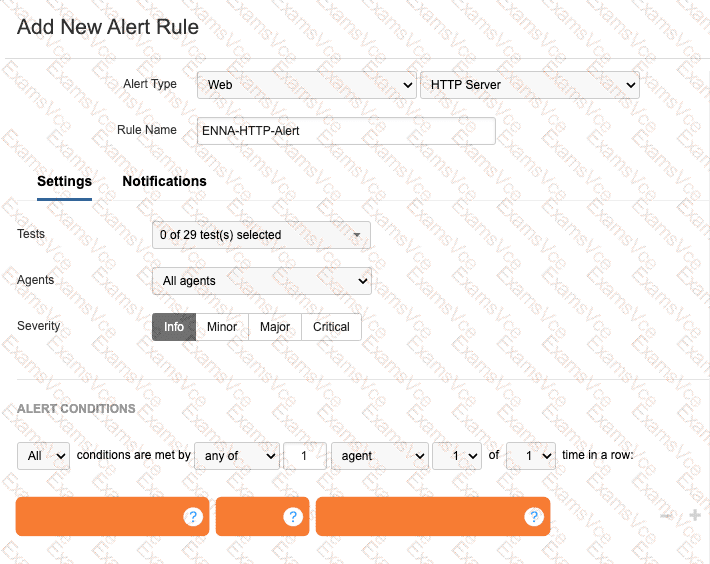
The requirement is to trigger an alert specifically when the HTTP server responds with aserver error. In the HTTP protocol, server errors are categorized as the5XXseries of status codes (e.g., 500 Internal Server Error, 503 Service Unavailable, 504 Gateway Timeout). To meet this requirement, the engineer must configure a location alert condition where theMetricis set toResponse Codeand the condition value isserver error(5XX)(Option D).
Reviewing the other options:
Error type is any (Option A):While this would capture server errors, it would also trigger for 4XX client errors (like 404 Not Found) and network-layer timeouts, making it too broad for a specific "server error" requirement.
Wait Time is Dynamic (Option B):This monitors the time-to-first-byte using statistical baselining. While high wait times oftenprecede5XX errors, this condition only alerts on latency, not on the actual error code itself.
Response Time (Option C):Similar to wait time, this monitors performance speed rather than the logical success or failure of the server's response.
By specifically selectingResponse Code: server error(5XX), the engineer ensures that the operations team is only notified when the application backend is experiencing a functional failure, rather than just a slow response or a client-side misconfiguration.