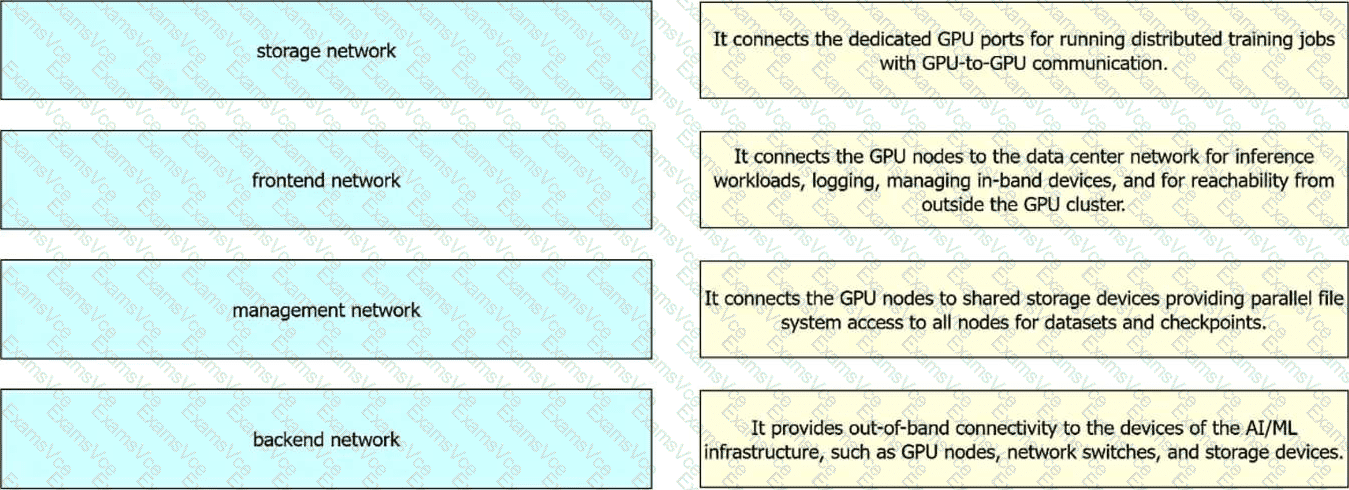
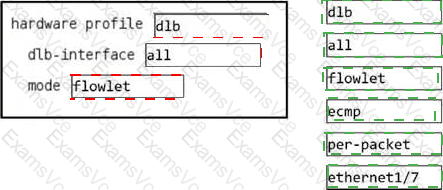
backend network
frontend network
storage network
management network
Large AI environments normally separate traffic into purpose-built fabrics because GPU collective communication, storage I/O, application access, and infrastructure management have fundamentally different performance and availability characteristics. Cisco identifies the backend network as the east-west fabric dedicated to inter-GPU communication. It carries high-bandwidth RoCEv2/RDMA traffic associated with distributed training and must provide exceptionally low latency and lossless behavior.
The frontend network provides north-south connectivity between AI nodes and the wider data center, supporting application access, inference traffic, general data movement, logging, and other in-band services. The storage network connects compute nodes to shared datasets, model checkpoints, and high-performance parallel or distributed storage systems. Cisco AI POD designs may use dedicated storage-leaf connectivity to prevent storage traffic from interfering with backend GPU collective communication. The management network serves out-of-band management interfaces for servers, switches, storage platforms, and other infrastructure components. Cisco AI reference architectures explicitly distinguish backend, frontend/storage, and management connectivity for these purposes.
Maintaining these traffic domains independently improves deterministic performance, fault isolation, congestion control, security, and operational manageability.
Study Guide Reference: AI Infrastructure Components and Architecture — network fabrics, bandwidth, latency, scalability, and AI infrastructure connectivity.
===============