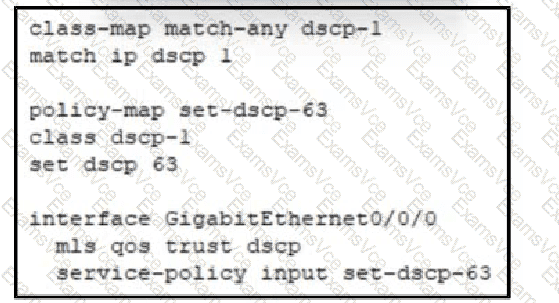
The correct answer is A. DSCP 1 marked traffic will be re-marked to 63 and all other DSCP values will be honored.
The exhibit shows:
class-map match-any dscp-1
match ip dscp 1
policy-map set-dscp-63
class dscp-1
set dscp 63
interface GigabitEthernet0/0/0
mls qos trust dscp
service-policy input set-dscp-63
The class map matches packets with DSCP value 1:
match ip dscp 1
The policy map then changes the DSCP marking of those matched packets to 63:
set dscp 63
The policy is applied in the input direction on interface Gig0/0/0:
service-policy input set-dscp-63
Also, the interface is configured to trust DSCP:
mls qos trust dscp
That means incoming packets keep their DSCP markings unless a QoS policy explicitly changes them. Since the policy only matches DSCP 1, only that traffic is re-marked to 63. Traffic with other DSCP values is not matched by the policy and therefore remains trusted and unchanged.
Traffic marked with DSCP 1 is matched by the class map.
The policy re-marks that traffic to DSCP 63.
All other DSCP-marked traffic is still trusted and therefore honored.
B. DSCP 1 marked traffic will be ignored and DSCP 63 marked traffic will be honored. Incorrect, because DSCP 1 traffic is not ignored. It is specifically matched and re-marked.
C. None. The service-policy configuration must be applied in the outbound direction. Incorrect, because QoS marking policies can be applied in the input direction, and this configuration is valid.
D. DSCP 1 marked traffic will be re-marked to 63 and all other DSCP values will be ignored. Incorrect, because other DSCP values are not ignored. They are trusted due to mls qos trust dscp .
When you see:
mls qos trust dscp → preserve incoming DSCP markings
service-policy input with set dscp → re-mark only the traffic matched by the policy
So here the result is:
DSCP 1 → changed to 63
All other DSCP values → trusted and left unchanged