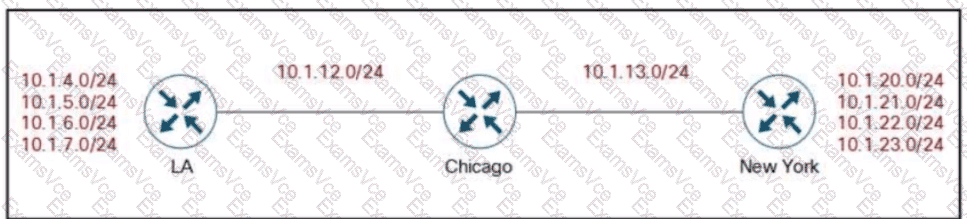
The issue described is classic route flapping, where a single unstable prefix (10.1.5.0/24) causes repeated route withdrawals and advertisements, triggering churn in the BGP control plane across the entire network. This behavior can be mitigated using the following scalable and non-disruptive design approach:
D. Route Aggregation: Aggregating routes at the edge router (in this case, the LA router) means that multiple more specific prefixes (such as 10.1.4.0/24 through 10.1.7.0/24) are advertised as a single summarized prefix (e.g., 10.1.4.0/22). As a result, the instability of 10.1.5.0/24 will not affect upstream routers (Chicago and New York), as they will only see the aggregated route.
Key benefits aligned with CCDE v3.1 design guidance:
Isolates flapping to the edge while maintaining reachability
Reduces control plane churn in BGP
Preserves scalability and simplifies the routing table in upstream routers
Why other options are incorrect:
A (Route dampening): While effective, route dampening is less favored today due to convergence delay and side effects; it’s also a reactive measure versus a design-based solution.
B and C (Filtering): Filtering the route prevents reachability to that subnet, which violates availability requirements and causes data black-holing.
Thus, aggregation is the most scalable, nondisruptive, and design-aligned choice in this context.