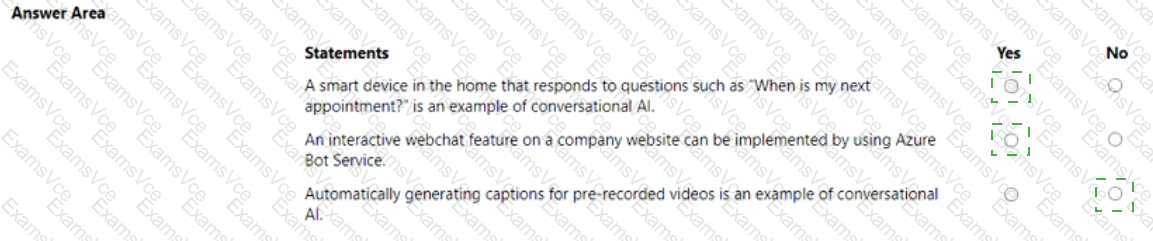
< Smart home device answering questions → Yes
Webchat using Azure Bot Service → Yes
Auto-caption generation for videos → No
According to the Microsoft Azure AI Fundamentals (AI-900) official study guide and the Microsoft Learn module “Describe features of common AI workloads”, Conversational AI refers to systems designed to engage in human-like dialogue through natural language—either text or speech. These systems include chatbots, virtual assistants, and voice-enabled smart devices, all of which can interpret user intent and respond meaningfully.
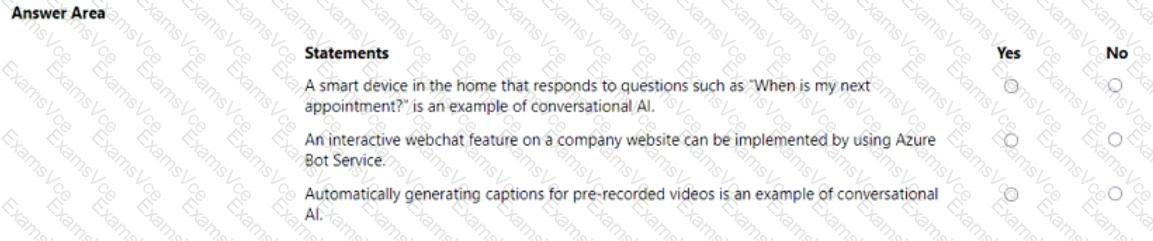
A smart device in the home that responds to questions such as “When is my next appointment?” – Yes.This is a classic example of Conversational AI. Devices like smart speakers or personal digital assistants use speech recognition, natural language understanding (NLU), and language generation to interpret spoken input and respond conversationally. The AI-900 study materials identify these as examples of voice-based conversational AI systems, which fall under the Speech and Language AI workloads.
An interactive webchat feature on a company website can be implemented by using Azure Bot Service – Yes.This statement is true. The Azure Bot Service is the primary Microsoft tool for creating and deploying conversational bots across various channels, including websites, Microsoft Teams, and other messaging platforms. The AI-900 syllabus specifically cites this as an example of implementing conversational AI for customer support or information retrieval.
Automatically generating captions for pre-recorded videos is an example of conversational AI – No.This is not conversational AI; instead, it falls under the Speech AI workload, specifically speech-to-text transcription. Automatically generating captions involves converting audio from video into written text but does not involve dialogue or interaction between a user and a system.
Thus, based on the official AI-900 guidance, only the first two scenarios describe conversational AI use cases.