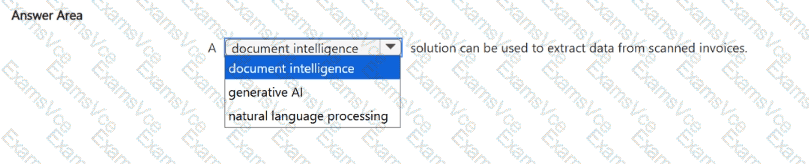
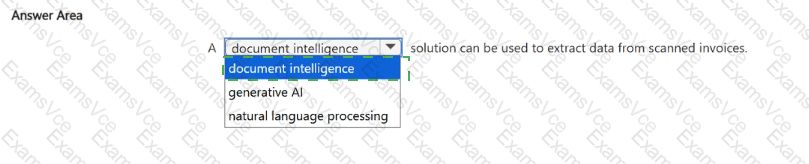
The correct answer is Document Intelligence.
According to the Microsoft Azure AI Fundamentals (AI-900) study materials and Microsoft Learn documentation, the Azure AI Document Intelligence service (formerly known as Form Recognizer) is specifically designed to extract structured data from documents, including scanned invoices, receipts, forms, and business cards.
This service combines optical character recognition (OCR) with machine learning to analyze both the layout and semantic meaning of document content. When processing scanned invoices, Document Intelligence identifies and extracts fields such as invoice numbers, dates, totals, taxes, vendor names, and line-item details. The extracted information can then be automatically imported into business systems like accounting software or databases, eliminating manual data entry and improving operational efficiency.
Here’s why the other options are incorrect:
Generative AI: Focuses on creating new content such as text, images, or code (for example, using GPT-4 or DALL·E). It is not used for structured data extraction.
Natural Language Processing (NLP): Deals with understanding and generating human language from text-based input, not document scanning or layout interpretation.
The Document Intelligence workload excels at handling semi-structured documents where the location and format of data vary between samples. Microsoft’s prebuilt models—like Invoice, Receipt, Identity Document, and Contract—simplify extraction without requiring custom training.
In summary, if the task involves extracting data from scanned invoices, the appropriate Azure AI service is Azure AI Document Intelligence, which uses AI-powered document understanding to convert unstructured document images into structured, usable data.