Classification
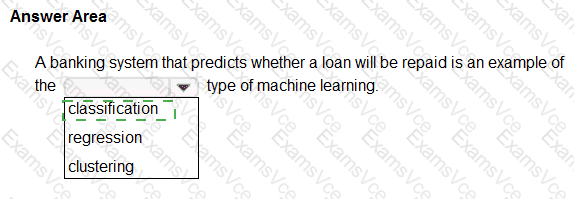
According to the Microsoft Azure AI Fundamentals (AI-900) official study guide and the Microsoft Learn module “Describe features of common AI workloads”, classification is a supervised machine learning technique used when the goal is to predict which category or class an item belongs to. In supervised learning, the model is trained with labeled data—data that already contains known outcomes. The system learns patterns and relationships between input features and their corresponding labels so it can predict future classifications accurately.
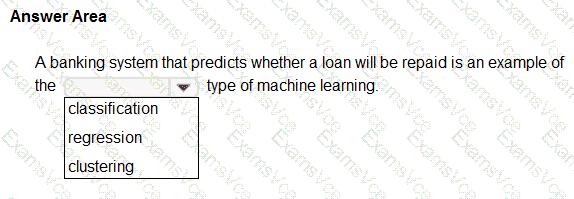
In the scenario provided — “A banking system that predicts whether a loan will be repaid” — the model’s output is a binary decision, meaning there are two possible outcomes:
The loan will be repaid (positive class)
The loan will not be repaid (negative class)
This kind of problem involves predicting a discrete value (a label or category), not a continuous numeric output. Therefore, it perfectly fits the classification type of machine learning.
The AI-900 learning materials describe classification as being used in many real-world examples, including:
Determining whether an email is spam or not spam.
Predicting whether a customer will churn (leave) or stay.
Detecting fraudulent transactions.
Assessing medical test results as positive or negative.
By contrast:
Regression predicts continuous numeric values, such as predicting house prices, temperatures, or sales revenue. It would not apply here because repayment prediction is not a numeric value but a categorical decision.
Clustering is an unsupervised learning method that groups similar data points without predefined categories, such as segmenting customers by purchasing behavior.
Thus, based on Microsoft’s Responsible AI and AI-900 study guide concepts, a banking system that predicts whether a loan will be repaid uses the Classification type of machine learning.