According to the Microsoft Azure AI Fundamentals (AI-900) Official Study Guide and the Microsoft Learn module “Explore natural language processing (NLP) in Azure”, Natural Language Processing (NLP) is a branch of artificial intelligence that focuses on enabling computers to understand, interpret, and generate human language. NLP is used to extract meaning and intent from text or speech, perform sentiment analysis, identify entities, and classify content based on context.
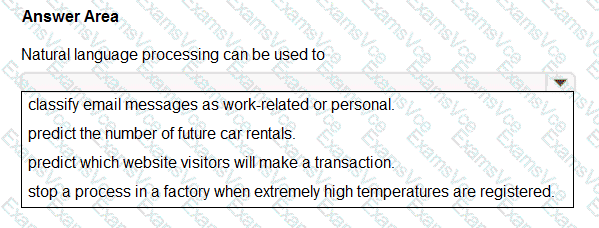
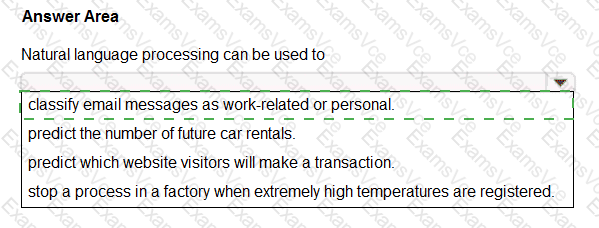
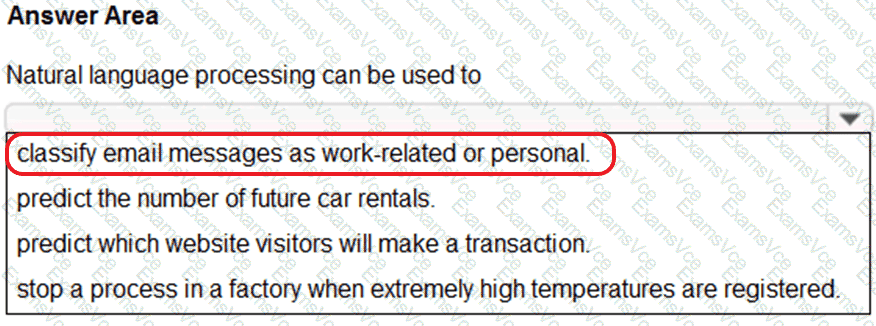
One of the primary applications of NLP is text classification, where an AI model automatically categorizes text documents or messages into predefined classes. Classifying emails as work-related or personal is a textbook example of this NLP capability. It involves analyzing the words, phrases, and structure of the text to determine the email’s category. Microsoft Learn highlights this type of problem as document classification, an essential NLP use case often implemented through Azure Cognitive Services such as Text Analytics or Language Studio.
Let’s examine why the other options are incorrect:
Predict the number of future car rentals – This is a time series forecasting or regression task, not NLP.
Predict which website visitors will make a transaction – This is a predictive analytics or machine learning classification problem based on behavioral data, not language understanding.
Stop a process in a factory when extremely high temperatures are registered – This relates to IoT automation or sensor-based anomaly detection, not NLP.
Therefore, based on Microsoft’s AI-900 materials, Natural Language Processing is best used for tasks involving understanding and classifying text, such as classifying email messages as work-related or personal. This example perfectly aligns with NLP’s goal—to enable machines to process and derive insights from human language inputs.