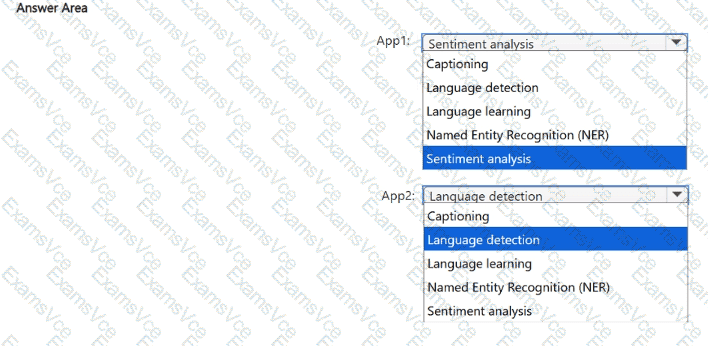
App1: “Understands the public perception of a brand or topic” → Sentiment analysis
According to the Microsoft Azure AI Fundamentals (AI-900) study guide and Microsoft Learn’s Natural Language Processing (NLP) documentation, Sentiment analysis is a feature of the Azure AI Language Service that determines the emotional tone or attitude expressed in text. It classifies text as positive, negative, neutral, or mixed, which makes it ideal for analyzing customer opinions, brand perception, or product feedback.
For example, an organization can use sentiment analysis to process customer reviews or social media posts to determine how people feel about a particular brand or topic. This insight helps companies assess customer satisfaction, public perception, and marketing impact.
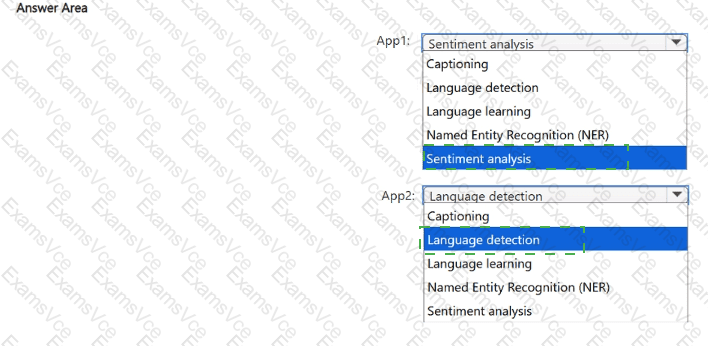
App2: “Applies profanity filters to speech-to-text” → Language detection
The task of applying profanity filters occurs during or after speech-to-text transcription, which involves identifying the language used so that the correct filter can be applied. Language detection is an NLP feature that determines which language is being spoken or written. Once the language is detected, appropriate profanity filtering rules are automatically applied to remove or mask offensive words from transcribed text.
Other options such as Captioning or Named Entity Recognition (NER) are not relevant:
Captioning describes images or videos, not speech filtering.
NER identifies people, locations, or organizations but does not handle profanity or language detection.
Therefore, based on Azure AI NLP features:
App1 uses Sentiment analysis
App2 uses Language detection