According to the PMBOK® Guide, there is a distinct and critical difference between Management and Leadership, though a successful project manager must balance both. The description in the question highlights the dual nature of these two roles:
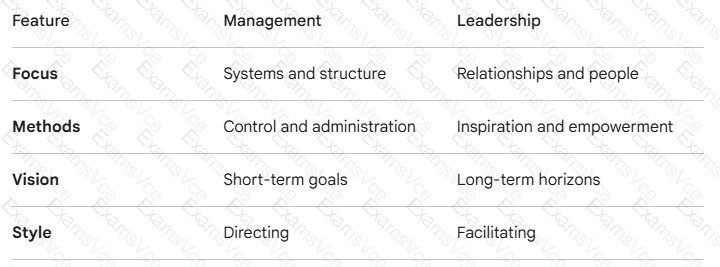
Management: This relates to directing another person to get from one point to another using a known set of expected behaviors. It focuses on systems, structures, administration, and results. Management is about doing things right, maintaining the status quo, and following the established plan (the " how " and " when " ).
Leadership: This relates to the ability to lead a team and inspire them to do their jobs well. It involves working with others through discussion or debate to guide them from one point to another. Leadership is about doing the right things, innovating, focusing on relationships, and inspiring trust (the " what " and " why " ).
Key Differences according to PMI:
Analysis of other options:
A. Influence and challenge: These are components or skills of leadership, but they do not capture the administrative " known set of expected behaviors " described in the first half of the question.
B. Innovation and administration: While " Innovation " is often a trait of leadership and " Administration " a trait of management, these are individual qualities rather than the core disciplines themselves.
D. Engagement and guidance: These are general terms used in stakeholder management and coaching, but they do not represent the formal PMI distinction between the two primary roles of a project manager.
Per PMI standards, the PMI Talent Triangle® emphasizes that a project manager must be competent in technical project management (Management) while also possessing the soft skills required to guide and motivate a team (Leadership).



