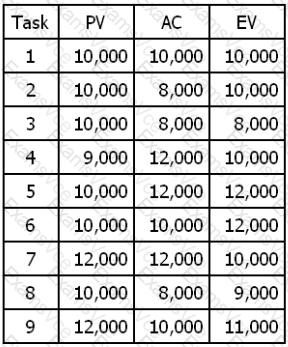
According to the PMBOK® Guide (Project Management Body of Knowledge), specifically within the Project Cost Management knowledge area and the Control Costs process, the Schedule Variance (SV) is a measure of schedule performance expressed as the difference between the earned value and the planned value.
To calculate the SV for Task 8 using the data provided in the table:
Identify the variables for Task 8:
Earned Value (EV) = 9,000
Planned Value (PV) = 10,000
Apply the SV Formula:
$$\text{SV} = \text{EV} - \text{PV}$$
$$\text{SV} = 9,000 - 10,000 = -1,000$$
Option B (-1,000): This is the correct calculation. A negative schedule variance indicates that the project is behind schedule compared to the plan. In this instance, Task 8 has accomplished $1,000$ less work than was scheduled to be completed by this point.
Option C (1,000): This would be the result if you incorrectly subtracted EV from PV ($10,000 - 9,000$). A positive SV would indicate the project is ahead of schedule, which is not supported by the Task 8 data.
Option A (-2,000): This would be the result if you incorrectly subtracted AC from PV ($8,000 - 10,000$). This calculation does not represent a standard Earned Value metric.
Option D (2,000): This result is mathematically inconsistent with the provided Task 8 figures.
In the PMI framework, the Schedule Variance (SV) is a critical indicator used in the Monitor and Control Project Work process. While it eventually reaches zero when the project is completed (because all PV is earned), during execution, it serves as an early warning sign that the project may require schedule compression techniques like crashing or fast-tracking to meet the baseline finish date.