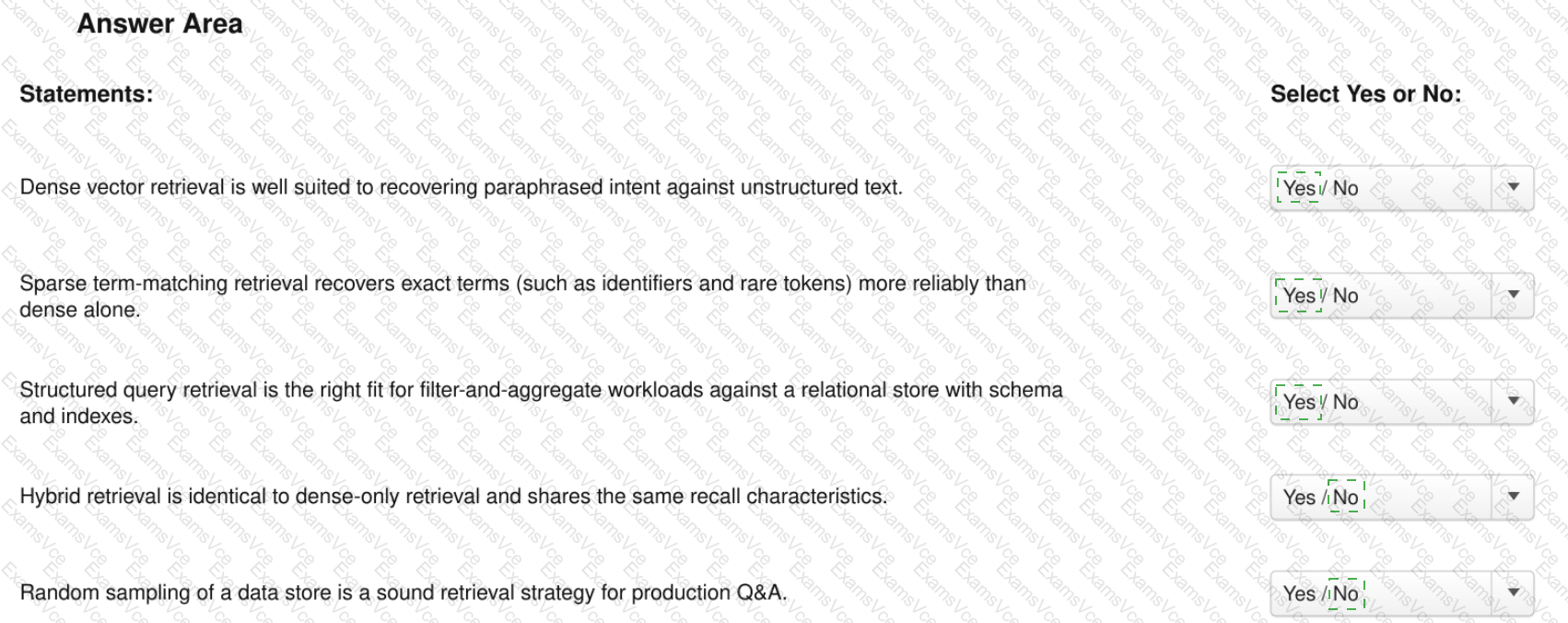
Yes, Yes, Yes, No, No
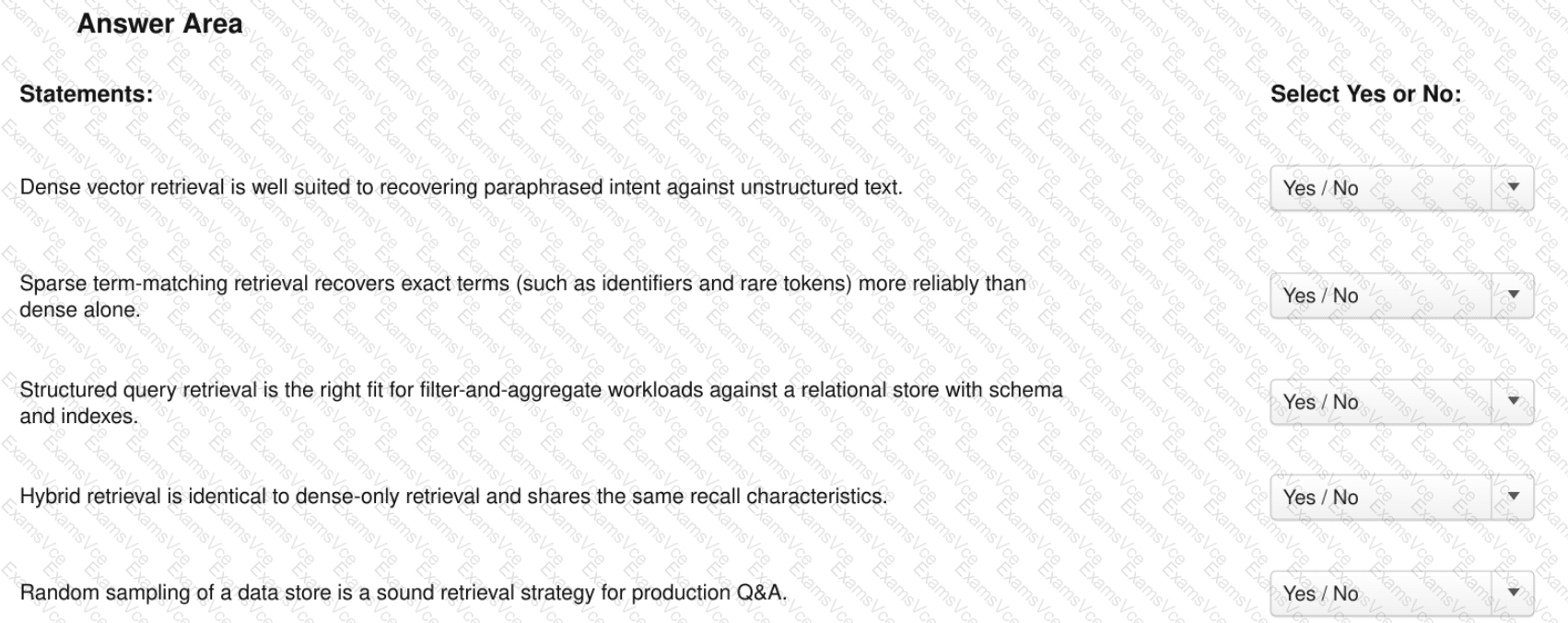
Dense vector retrieval represents semantic similarity, making it suitable for matching paraphrases and conceptually related language even when the query and source do not share identical words. Sparse lexical retrieval, including BM25-style matching, retains strong sensitivity to exact tokens and is therefore valuable for identifiers, product codes, technical names, and uncommon terminology.
Structured query retrieval is appropriate when the required operation depends on explicit fields, predicates, joins, counts, grouping, or aggregation over a relational schema. In that situation, generating or invoking a constrained database query is more precise than approximating the operation through semantic similarity.
Hybrid retrieval is not identical to dense retrieval. It combines semantic and lexical candidate sets, typically followed by rank fusion or reranking. Anthropic’s contextual-retrieval guidance explains that semantic search captures meaning and paraphrases, while BM25 captures exact terminology; combining them improves coverage. Contextual Retrieval , Contextual Retrieval Cookbook
Random sampling is not a relevance strategy. It provides no systematic relationship between the query and selected evidence, producing unstable coverage and preventable hallucination risk. Production Q & A requires deterministic or evaluated relevance mechanisms, access filters, suitable indexes, and measurable retrieval metrics such as recall at k .
Study Guide references/topics: Dense retrieval; sparse retrieval; structured queries; hybrid search; rank fusion; retrieval evaluation; production RAG design.
===============