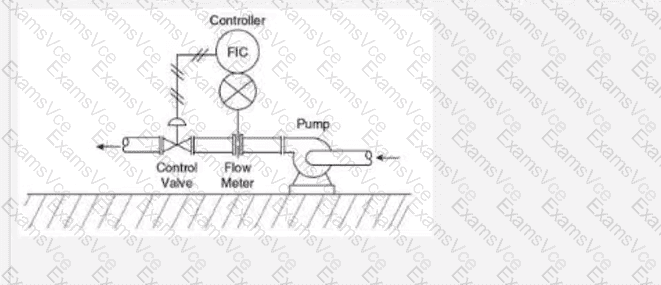
The correct answers are B and D because a typical flow control loop (including flow meter, controller, control valve, and associated instrumentation) behaves as a series system from a reliability perspective, as described in CCPS risk analysis and Layer of Protection Analysis (LOPA) principles.
In a series system , the system fails if any single component fails , which supports answer D . For example, if the flow transmitter gives incorrect readings, or the control valve fails to actuate, the loop can no longer maintain proper control. This aligns with CCPS guidance that basic process control systems (BPCS) are generally not highly reliable independent protection layers due to multiple potential failure points.
For such systems, the overall reliability is calculated by multiplying the reliabilities of individual components , which supports answer B . Each component must function correctly for the system to succeed.
Option A is incorrect because failure probabilities are not simply multiplied in this context; instead, reliability (success probability) is multiplied, and failure probability is derived from the complement. Option C is incorrect because it describes a parallel system, where all components must fail for system failure—this is not applicable to a standard control loop.
This concept is critical in CCPS hazard analysis and LOPA when evaluating safeguard effectiveness and independence.