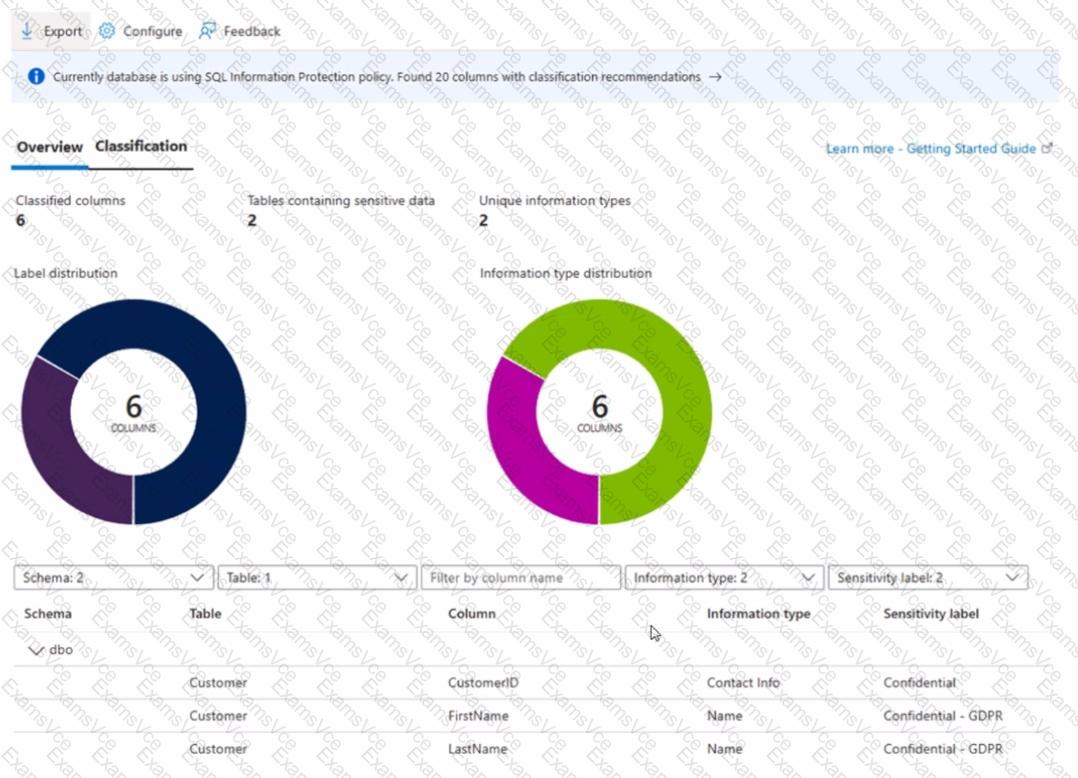
Basic Concept: This question tests plan and implement data platform resources in the DP-300 exam context. The correct choice is determined by the exact service boundary and operational requirement stated in the scenario.
Why D and E is Correct: Select the Classification page. is correct because it is the feature whose normal purpose matches the stated requirement. Select the Classification page. is an Azure data-platform feature, but it must match the workload model, service tier, migration path, or deployment constraint described in the scenario. The scenario wording points to that specific behavior: You need to identify the process for creating a custom sensitivity label and assigning it to the CustomerlD column. Select Configure is correct because it is the feature whose normal purpose matches the stated requirement. Select Configure is an Azure data-platform feature, but it must match the workload model, service tier, migration path, or deployment constraint described in the scenario. The scenario wording points to that specific behavior: You need to identify the process for creating a custom sensitivity label and assigning it to the CustomerlD column.
Why A is Wrong: Select Export is an Azure data-platform feature, but it must match the workload model, service tier, migration path, or deployment constraint described in the scenario. It mismatches the target platform, migration method, compute tier, or deployment model described in the scenario, so it would not satisfy the workload as stated.
Why B is Wrong: Filter by the Contact Info Information type- is an Azure data-platform feature, but it must match the workload model, service tier, migration path, or deployment constraint described in the scenario. It applies to a different Azure data-platform design than the one the question is testing.
Why C is Wrong: Filter by the CustomerlD column name. is an Azure data-platform feature, but it must match the workload model, service tier, migration path, or deployment constraint described in the scenario. It would solve a neighboring problem, but not the deployment, sizing, or migration requirement in this item.