Comprehensive and Detailed Explanation From NCC-Aligned Sources:
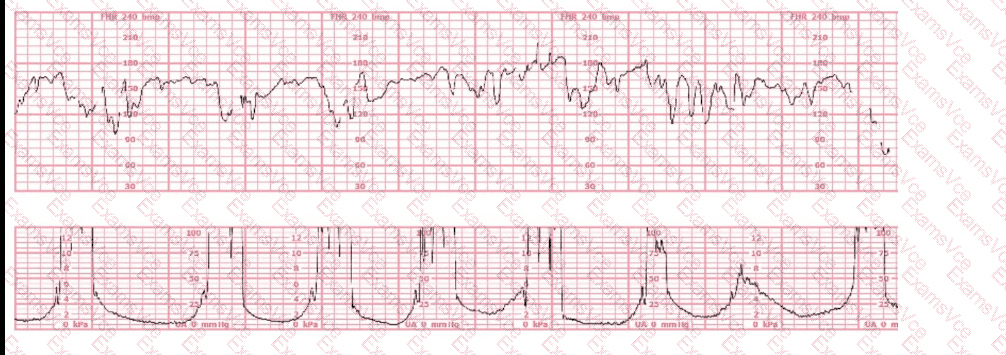
The tracing shows the classic features of variable decelerations:
Abrupt onset (<30 seconds from baseline to nadir)
Rapid drop followed by a rapid recovery
Significant variability in shape, depth, and timing
“Shouldering”—brief accelerations before or after the deceleration, typical of cord compression
The decelerations vary in appearance and timing relative to contractions
In second stage, this pattern is extremely common due to:
Recurrent cord compression during descent
Maternal pushing
Reduced amniotic fluid with advancing labor
Why the other options are incorrect:
A. Intermittent late decelerations
Late decelerations are uniform, smooth, begin after the contraction peak, and recover after the contraction ends.
This tracing shows abrupt, variable-shaped, non-uniform decels → NOT late decels.
C. Wandering baseline
A wandering baseline is a slowly fluctuating, low-amplitude, smooth, preterminal pattern.
This tracing shows an identifiable baseline with variability and clear decelerations, not wandering baseline.
Thus, the tracing is most consistent with variable decelerations.
[References:NCC C-EFM Candidate Guide; AWHONN FHMPP; NICHD FHR Definitions; Menihan Electronic Fetal Monitoring; Simpson & Creehan Perinatal Nursing; Creasy & Resnik Maternal-Fetal Medicine., ]