Comprehensive and Detailed In-Depth Explanation:
Understanding OSPF Path Selection and Cost Calculation:
The OSPF cost is determined by the cumulative sum of interface costs along a path.
By assigning specific costs to A, B, and C, we can influence OSPF’s path selection to meet the desired routing behavior.
Step-by-Step Analysis of Required Traffic Flow:
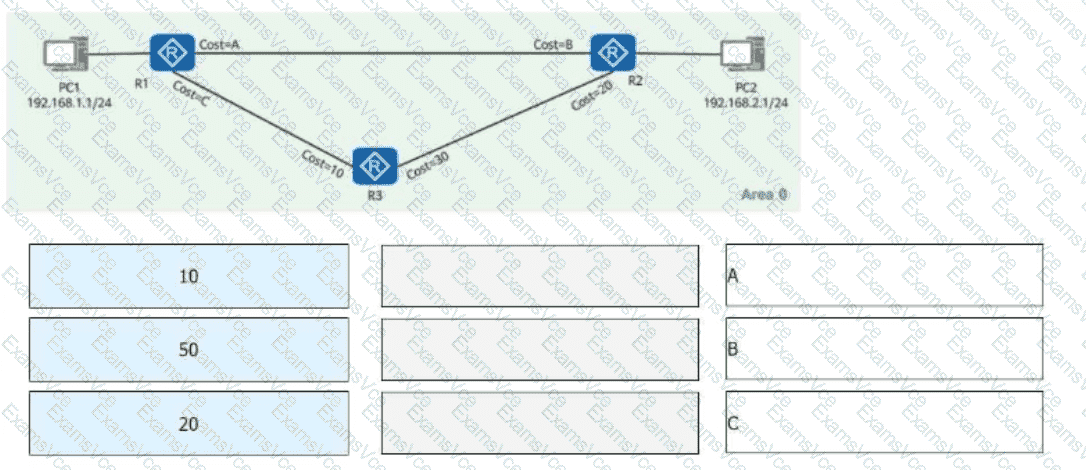
1. Traffic from PC1 to PC2 must take the route:
PC1 - > R1 - > R3 - > R2 - > PC2
To force traffic through R3, the cost of the direct link R1 - > R2 (Cost-A) must be higher than the alternative path via R3.
We assign Cost-A = 50 (high cost) to discourage direct routing from R1 - > R2.
The cost of R1 - > R3 (Cost-C) should be lower, so we assign Cost-C = 20.
The cost of R3 - > R2 (default Cost-20) remains unchanged.
Total cost via R3: 20 (R1- > R3) + 20 (R3- > R2) = 40, which is less than the direct link of 50, so OSPF prefers this path.
✅ Traffic follows: PC1 - > R1 - > R3 - > R2 - > PC2
2. Traffic from PC2 to PC1 must take the route:
PC2 - > R2 - > R1 - > PC1
Assign Cost-B = 10 (low cost).
This ensures that R2 prefers the direct path R2 - > R1 instead of R2 - > R3 - > R1 (which costs 20+20=40).
✅ Traffic follows: PC2 - > R2 - > R1 - > PC1
Final Cost Assignments for Correct Routing Behavior:
Cost
Assigned Value
Reason
Cost-A (R1 - > R2)
50
High to discourage direct R1- > R2 routing
Cost-B (R2 - > R1)
10
Low to ensure PC2- > PC1 prefers direct R2- > R1
Cost-C (R1 - > R3)
20
Medium to encourage R1- > R3- > R2 path
Key Takeaways:
Lower OSPF cost encourages path selection.
By manipulating OSPF cost values, we achieve asymmetric routing between PC1 and PC2.
This aligns with OSPF path selection principles covered in HCIP-Datacom certification.
HCIP-Datacom-Advanced Routing & Switching Technology References:
Huawei HCIP-Datacom Official Certification Guide, Chapter on OSPF Cost Calculation and Path Selection.
Huawei Enterprise Networking Training Materials, OSPF Path Optimization Techniques.
Huawei Datacom Configuration Guide, OSPF Cost and Traffic Engineering.