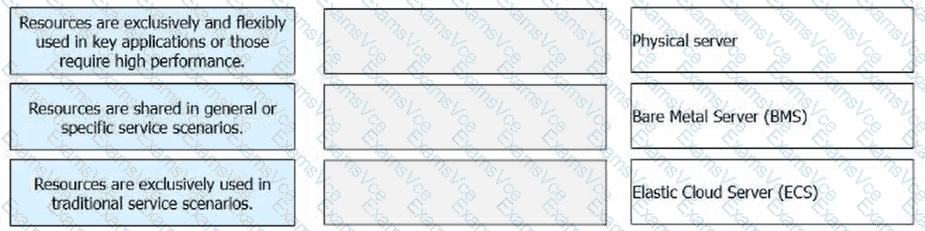
1 → Bare Metal Server (BMS)
2 → Elastic Cloud Server (ECS)
3 → Physical server
The first scenario maps to BMS because Bare Metal Servers combine exclusive access to physical resources with cloud-oriented provisioning and management. Huawei Cloud recommends BMS for key or mission-critical applications and services requiring high performance. BMS retains direct physical CPU and memory access while supporting capabilities such as automatic provisioning, VPC networking, image deployment, monitoring, and cloud storage. It therefore provides both resource exclusivity and cloud flexibility .
The second scenario maps to ECS . ECS instances operate on virtualized infrastructure, so physical server resources can be shared among virtual machines. This model is appropriate for general-purpose and specialized cloud workloads where virtualization, rapid deployment, elasticity, and efficient resource utilization are priorities.
The third scenario maps to a traditional physical server . A physical server also provides exclusive resources, but Huawei's comparison shows that traditional servers do not inherently provide cloud capabilities such as automatic provisioning, VPC integration, image-based deployment, and standardized cloud monitoring. This makes them characteristic of traditional dedicated-service environments.
Huawei's comparison explicitly records exclusive resources for BMS and physical servers, but not ECS.
Reference topics: BMS, Physical Server, and ECS Comparison; Resource Exclusivity; Automatic Provisioning; Compute Architecture.
===============