Comprehensive and Detailed Explanation
HPE Press guide context | PDF page 818 | HPE Press, Aruba Certified Associate – Campus Access Official Certification Study Guide
Technical Deep Dive — Original Chat Wording
IEEE 802.1X authentication uses an endpoint supplicant, a network authenticator, and an authentication server.
In this scenario, the corporate laptop successfully connects through AP4 but cannot authenticate through AP3.
Because the same laptop and employee network operate successfully through AP4, the client's credentials and general authentication-service availability are less likely to be the underlying problem.
The presence of a RADIUS error in ClearPass is an important diagnostic clue.
RADIUS communication relies on a shared secret configured between the RADIUS client and the authentication server.
If the secret configured for an AP's RADIUS client identity does not match the corresponding secret in ClearPass, authentication packets may fail validation.
This can prevent a valid endpoint from completing the authentication process.
The technician should examine the ClearPass Event Viewer to identify the specific error.
Next, the technician should verify the RADIUS client entry corresponding to AP3, including its IP address and shared secret.
The ClearPass configuration must match the shared secret used by the actual RADIUS client.
In some Aruba architectures, a gateway or controller acts as the RADIUS client instead of the individual AP. In that case, the appropriate gateway or controller entry must be checked.
Change of Authorization is used to modify an established authorization state and is not the initial corrective action for a shared-secret mismatch.
The SSID configuration is reported as identical on both APs.
Therefore, Option D (Verify the RADIUS passphrase for AP3 in ClearPass) is the best answer.
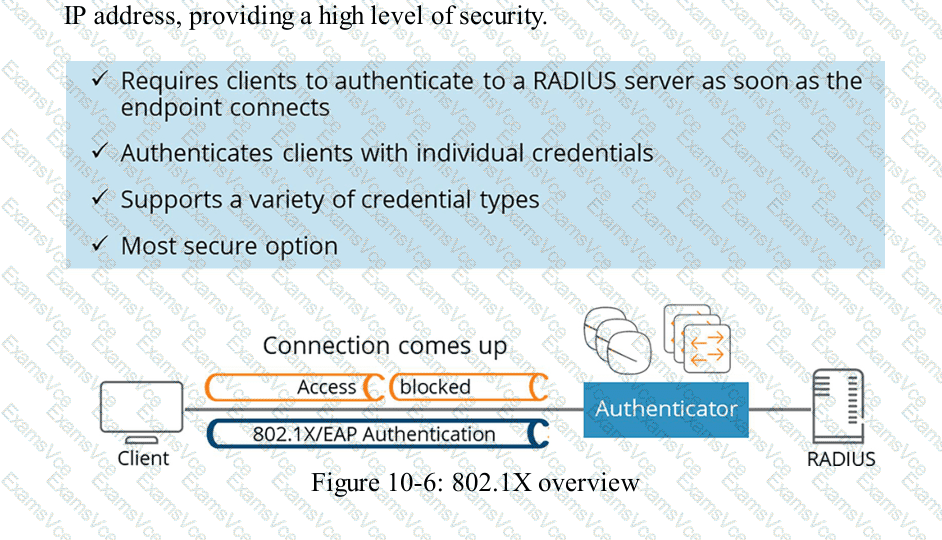
HPE Press study-guide figure / related learning illustration · Q180 Fig 10-6 8021X