Comprehensive and Detailed Explanation
HPE Press guide context | PDF page 843 | HPE Press, Aruba Certified Associate – Campus Access Official Certification Study Guide
Technical Deep Dive — Original Chat Wording
The troubleshooting information indicates that the wireless client's basic connectivity is functioning.
The client successfully associates with the new SSID, acquires an IP address, and resolves DNS names. This demonstrates that several essential network services are available.
Furthermore, the existing SSID provides internet connectivity through the same VLAN.
These observations reduce the likelihood of a general Layer 3 routing or internet-uplink failure.
The most important difference is the new role assigned to clients connecting through the new SSID.
Aruba user roles determine which traffic clients are permitted to send and receive.
Their firewall policies can permit or deny traffic according to source, destination, protocol, application, and other supported conditions.
A misconfigured rule can allow DHCP and DNS while blocking HTTP or HTTPS traffic.
Rule processing order can also determine the effective authorization result when multiple rules match a traffic flow.
The technician should examine the client's effective role, verify the applied firewall policy, and confirm that the intended internet-access rules are evaluated correctly.
It is also important to verify any implicit deny behavior. However, merely confirming that the implicit deny appears last does not prove that the required permit rules are correct.
The SSID already broadcasts and accepts associations, making Option C irrelevant to the observed failure.
Therefore, Option B is correct.
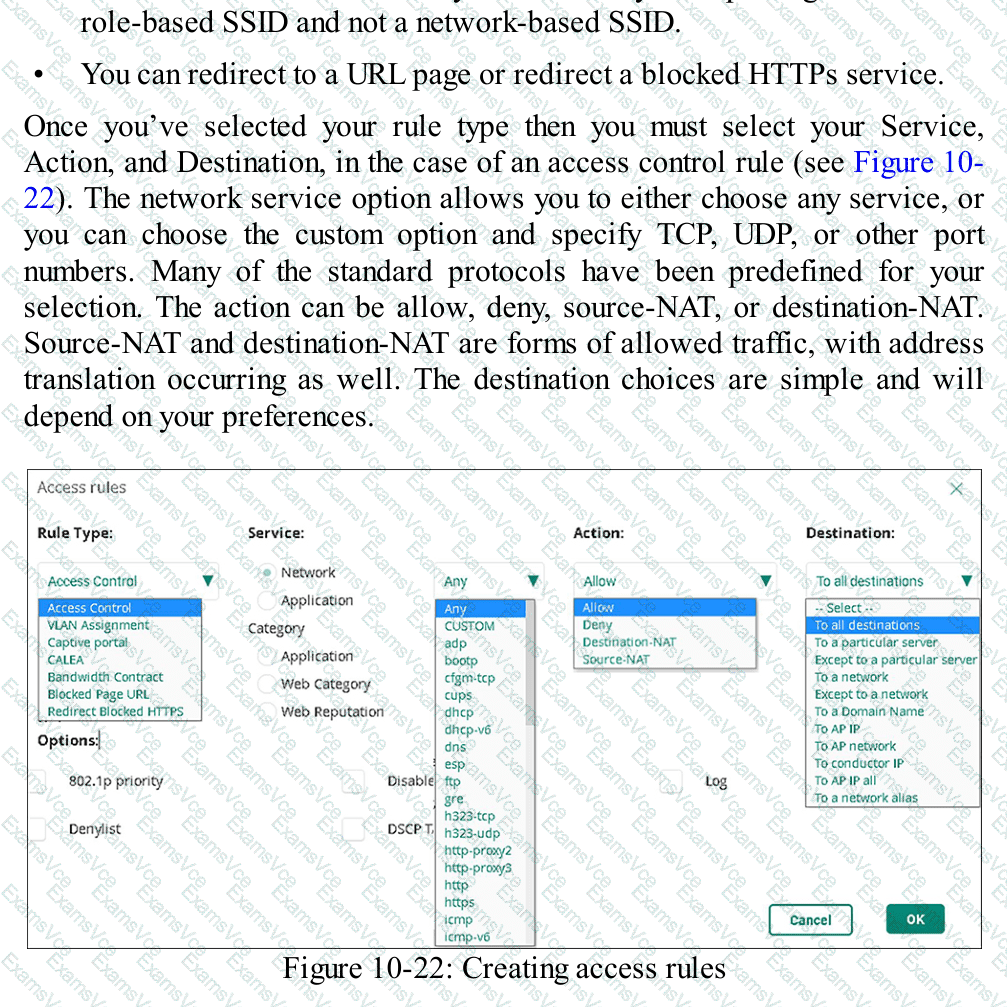
HPE Press study-guide figure / related learning illustration · Q107 Fig 10-22 Access Rules



