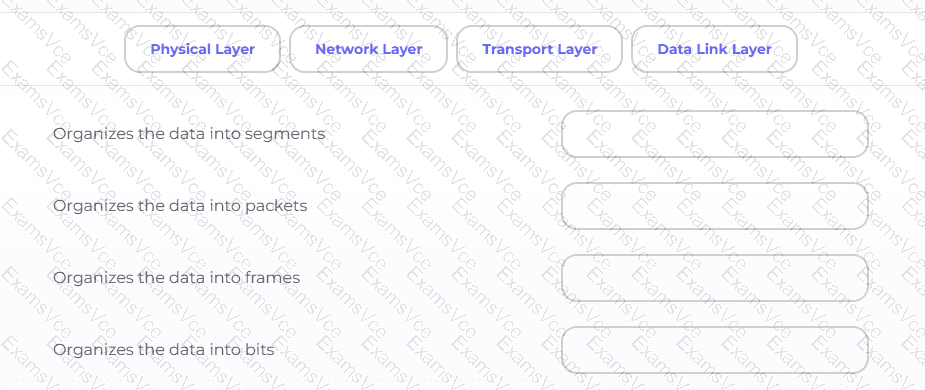
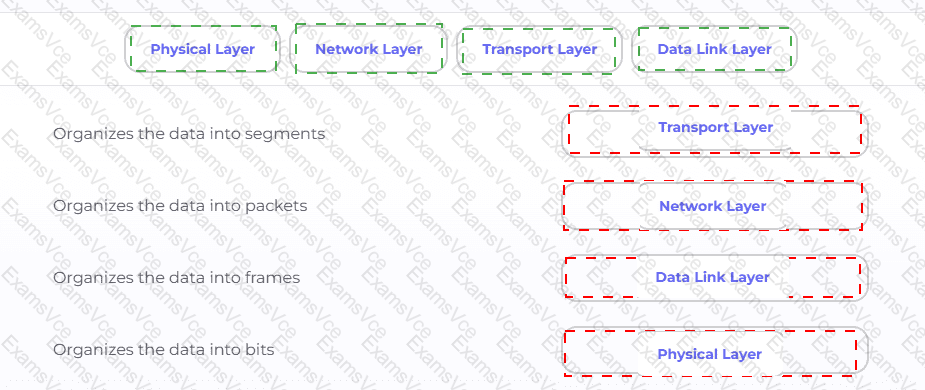
See mapping
Exhibit item
Correct match
Physical layer
Bits
Data link layer
Frames
Network layer
Packets
Transport layer
Segments
Comprehensive and Detailed Explanation
HPE Press guide context | PDF page 35 | HPE Press, Aruba Certified Associate – Campus Access Official Certification Study Guide
Technical Deep Dive — Reconstructed (Original Chat Text Not Recoverable)
In OSI encapsulation, an application produces data, the transport layer forms segments, the network layer forms packets, the data-link layer produces frames, and the physical layer transmits bits/signals. De-encapsulation reverses this order at the receiver. Match processing phases to the corresponding layer rather than equating frames with Layer 3 packets.
The exhibit is a matching question: each original item must be paired with the applicable protocol, medium, security function, or address classification. The answer table below records the intended correspondence without changing the source exhibit.
Operational workflows should preserve consistent inventory, authorization, configuration history, and monitoring so that administrators can locate and manage devices predictably.
The operational view should be interpreted together with its underlying records: an alert, subscription count, or device status may describe management state rather than physical availability.
The answer should be validated against both the control-plane state and the forwarding or management outcome. A successful individual command alone is not proof that the end-to-end requirement is satisfied.
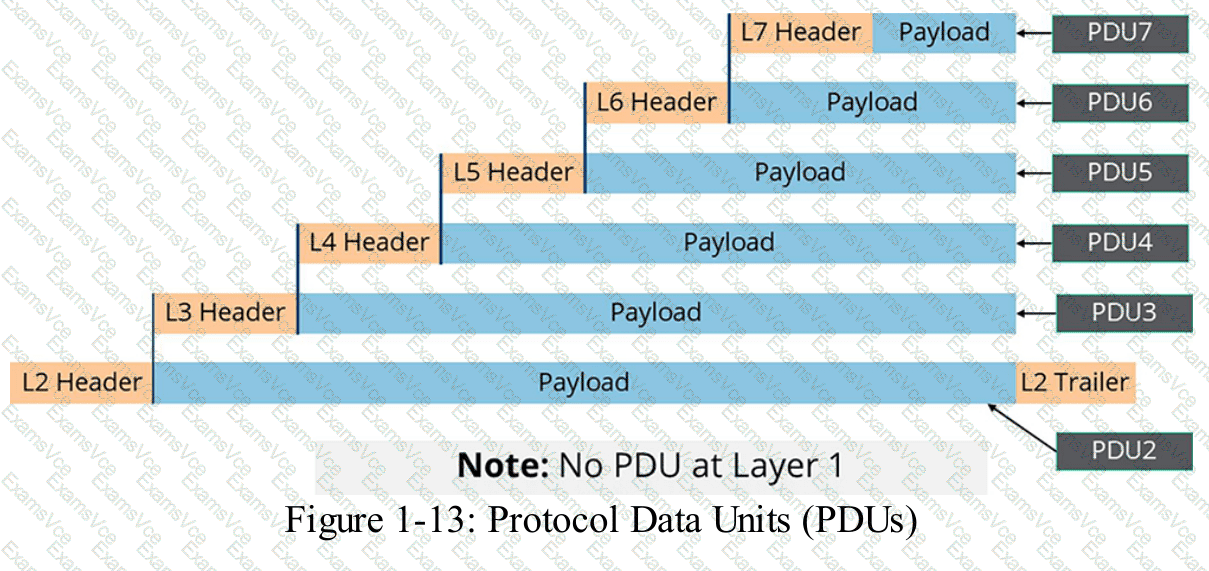
HPE Press study-guide figure / related learning illustration · Fig 1-13 PDU