Comprehensive and Detailed Explanation
HPE Press guide context | PDF page 815 | HPE Press, Aruba Certified Associate – Campus Access Official Certification Study Guide
Short exact extract: “Layer 3 authentication takes place after the client receives an active layer 2 connection.”
Technical Deep Dive — Original Chat Wording
Captive portal authentication is commonly used for guest access in enterprise campus environments.
Unlike IEEE 802.1X, which controls network access during the Layer 2 authentication process, a captive portal typically operates after the endpoint has associated with the WLAN and acquired IP connectivity.
A wireless client first completes the ordinary 802.11 association procedure.
The client can then obtain an IP address through DHCP and resolve required network names using DNS.
Before successful captive portal authentication, the assigned access policy generally restricts communication to essential services and approved authentication destinations.
When the user initiates supported web traffic or captive-network detection, the network presents or redirects the user to a portal.
The user may authenticate using guest credentials, a sponsor-generated account, or a supported external identity provider.
Following successful authentication, the infrastructure applies the appropriate authorization policy.
HPE Aruba Networking supports captive portal implementations through Aruba Central and ClearPass Guest.
MAC authentication is based on a client's hardware address. IEEE 802.1X uses EAP-based authentication at the network access layer.
Captive portal authentication differs because it uses IP connectivity and web-based interaction after initial network association.
The portal itself does not replace the need for appropriate wireless encryption and secure transport.
Therefore, Option B (Layer 3 authentication) is correct.
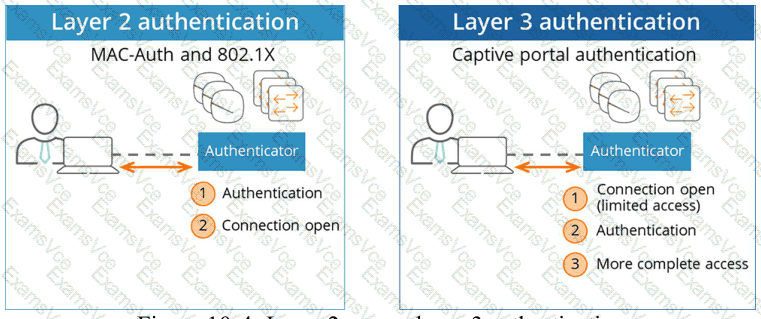
HPE Press study-guide figure / related learning illustration · Fig 10-4 L2 L3 auth