Comprehensive and Detailed Explanation
HPE Press guide context | PDF page 818 | HPE Press, Aruba Certified Associate – Campus Access Official Certification Study Guide
Technical Deep Dive — Original Chat Wording
IEEE 802.1X provides port-based network access control and is a standard approach for securing enterprise wireless networks.
It uses three main components: the supplicant, authenticator, and authentication server.
The supplicant is the employee's endpoint, such as a laptop or smartphone.
The authenticator is typically the wireless access point, while the authentication server commonly uses RADIUS.
In an HPE Aruba Networking deployment, ClearPass Policy Manager can provide centralized authentication and authorization services.
When an employee attempts to connect, the AP exchanges EAP authentication information between the client and authentication server.
The server evaluates the credentials and determines whether access should be granted.
The resulting authorization can include user roles, VLAN information, or other supported policy attributes.
Certificate-based EAP-TLS is particularly suitable for managed enterprise devices because it provides strong mutual authentication.
MAC authentication is weaker because MAC addresses can be observed and spoofed.
Individual PSKs can improve security in certain environments, but enterprise 802.1X provides more comprehensive identity-based control.
A shared passphrase for all employees introduces unnecessary credential-sharing and revocation risks.
Therefore, Option C (Use 802.1X authentication for employee access) is correct.
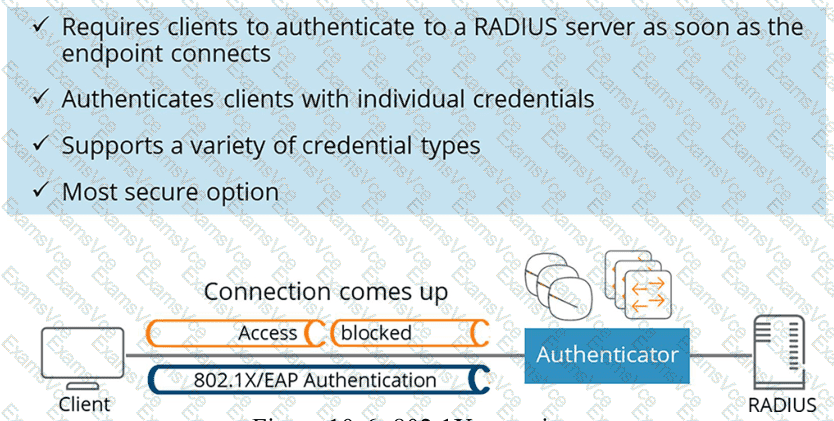
HPE Press study-guide figure / related learning illustration · Q162 Fig 10-6 8021x