Comprehensive and Detailed Explanation
HPE Press guide context | PDF page 589 | HPE Press, Aruba Certified Associate – Campus Access Official Certification Study Guide
Technical Deep Dive — Original Chat Wording
A device function identifies the role that a managed device performs in the network.
In the newer HPE Aruba Networking Central configuration architecture, device functions help determine which configuration profiles can be applied to infrastructure.
For switches, supported functions include Access Switch, Aggregation Switch, and Core Switch.
For wireless infrastructure, supported functions include Campus Access Point and Microbranch Access Point.
The device function is important because different infrastructure roles require different configuration capabilities.
For example, a Campus Access Point may need WLAN SSID profiles, radio-related settings, and wireless access policies.
An access switch instead requires profiles associated with Ethernet ports, switching, and supported authentication functions.
Central uses the assigned function to present applicable configuration workflows and profile categories.
This prevents administrators from treating devices with fundamentally different responsibilities as interchangeable configuration targets.
The official function identifier for Campus Access Point is CAMPUS_AP .
Top-Of-Rack switch, Branch router, and Edge switch are descriptive networking terms, but they are not the exact supported device-function names in the official list.
The distinction matters because examination questions may use terms that sound architecturally reasonable without matching Central's actual configuration terminology.
Therefore, Option B (Campus Access Point) is correct.
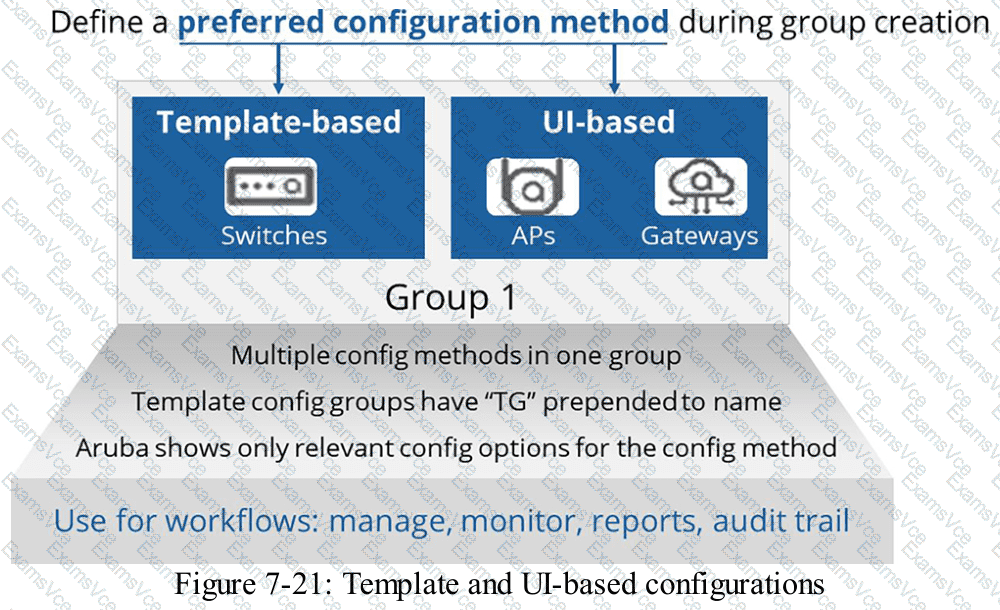
HPE Press study-guide figure / related learning illustration · Q183 Fig 7-21 config



