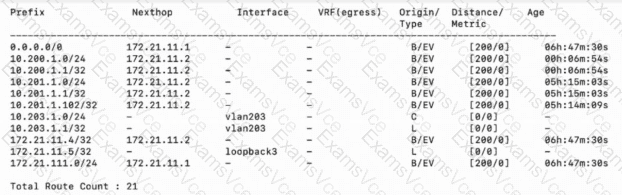
The CLI output shown is from the Aruba CX 6300 running AOS-CX, displaying the routing table in an EVPN-VXLAN fabric environment.
Key details from the output:
Prefix Nexthop Interface Origin/Type Distance/Metric
10.203.1.0/24 - vlan203 C [0/0]
10.203.1.1/32 - vlan203 L [0/0]
10.203.1.100/32 172.21.11.2 - B/EV [200/0]
172.21.11.4/32 172.21.11.2 - B/EV [200/0]
172.21.11.5/32 - loopback3 L [0/0]
From this, we can interpret the following:
Routes marked as B/EV originate from BGP EVPN, meaning they are advertised and learned over the VXLAN fabric.
The next hop 172.21.11.2 indicates that these routes are learned from another fabric device with loopback address 172.21.11.2.
The route 10.203.1.100/32 is a host route (specific endpoint) reachable via that remote switch.
According to the Aruba CX EVPN-VXLAN Fabric Deployment Guide:
“In a VXLAN fabric, host routes (/32) are dynamically advertised using EVPN Type 2 routes.
These routes include MAC/IP bindings of endpoints connected to remote VTEPs (loopbacks).
The next-hop address in the routing table corresponds to the VTEP IP (loopback address) of the remote switch where the client resides.”
Thus, the presence of a /32 route (10.203.1.100/32) with next hop 172.21.11.2 indicates that this wired client resides behind another CX 6300 fabric node whose VTEP address is 172.21.11.2.
Option Analysis:
A. Correct – The /32 route confirms that 10.203.1.100 is reachable via remote CX at 172.21.11.2 (remote VTEP).
B. Incorrect – The RD information isn’t shown here; this statement cannot be validated and contradicts visible EVPN entries.
C. Incorrect – The route is properly advertised and reachable via EVPN; no indication of advertisement failure.
D. Incorrect – Overlay loopbacks (172.21.11.x) are advertised as /32 host routes, not /24 subnets.
Final Verified Answer: A
Reference Sources (HPE Aruba Official Materials):
Aruba CX 6300 Routing and BGP Configuration Guide
Aruba Certified Switching Professional (ACSP) Study Guide – EVPN-VXLAN Route Interpretation