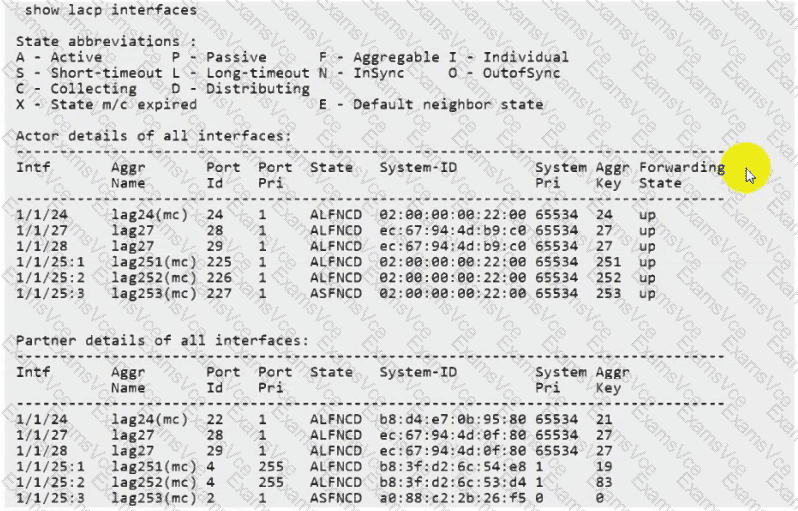
The key evidence is the Actor State for the local lag253(mc) interface. Its state is shown as:
ASFNCD
According to the AOS-CX show lacp interfaces state abbreviations, A means Active, S means Short-timeout , F means Aggregable, N means InSync, C means Collecting, and D means Distributing. Aruba Networks
The significant difference is the S (Short-timeout) state. Other local LAGs in the exhibit show ALFNCD, where L means Long-timeout . AOS-CX uses the slow LACP rate by default , which requests LACP heartbeat transmission every 30 seconds with a 90-second timeout. Configuring lacp rate fast changes this behavior to approximately one-second LACP heartbeats and a three-second timeout. Therefore, the S state on local lag253 demonstrates that this LAG has been explicitly configured away from the default behavior—hence it has a custom LACP rate configuration . Aruba Networks
Option B is not supported by the operational state. Although the partner displays an aggregator key of 0, lag253 is InSync, Collecting, and Distributing , and its forwarding state is up . Thus, the output does not indicate that a different partner aggregator key is required. lag27 likewise shows normal aggregation with both members using the same aggregation key.
Study Guide References: LACP State Flags; show lacp interfaces; LACP Fast/Slow Rate; Short and Long Timeout; VSX Multi-Chassis LAG.