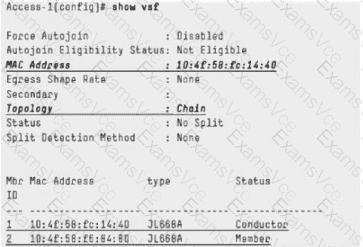
The exhibit shows the output of the show vsf command on a two-member Virtual Switching Framework (VSF) stack. To determine the outcome of a failover, we must look at the assigned roles and the secondary member configuration.
Analyzing the Roles: * Member 1 is the Conductor (the master controller).
Member 2 is a Member (a subordinate switch).
The Secondary Member Requirement: In VSF, high availability is not automatic just by having two switches. You must explicitly designate a Secondary member to act as the " Standby " for the Conductor. In the exhibit, the line Secondary : is blank.
Failure Scenario: * If Member 1 (Conductor) fails, Member 2 will look to see if it is the designated Secondary.
Since no Secondary is configured, Member 2 has no authority to take over the control plane or management functions of the stack.
Member 2 will remain in the " Member " state. Because the Conductor is gone and there is no Standby to promote, the logical stack effectively collapses; Member 2 will likely reboot or lose its configuration context because it has no Conductor to sync with. It certainly will not become the Conductor.
Best Practice Correction: To fix this, an administrator should have run the command vsf secondary-member 2. This would have changed Member 2 ' s status from " Member " to " Standby " (or Secondary), allowing it to transition to " Conductor " if Member 1 failed.