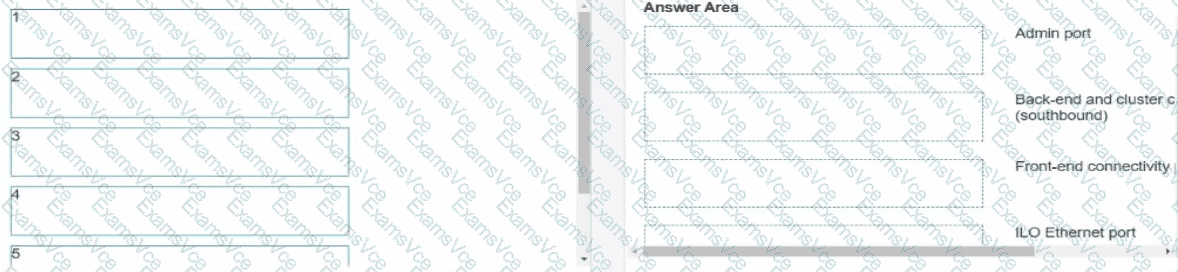
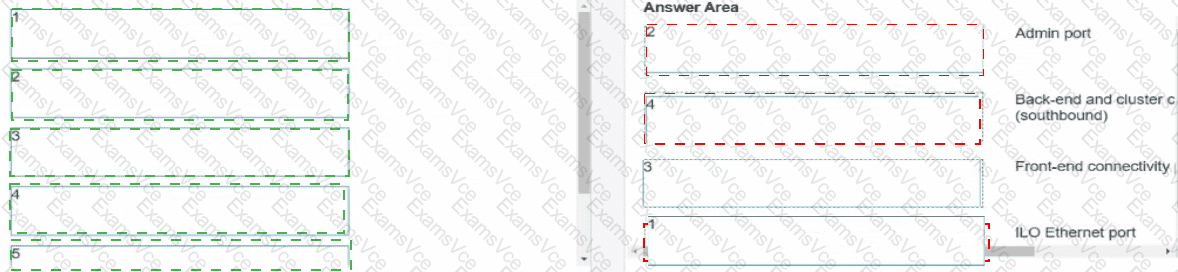
Admin port: 2
Back-end and cluster connectivity (southbound): 4
Front-end connectivity (northbound): 3
iLO Ethernet port: 1
The HPE Alletra MP B10000 architecture is defined by its disaggregated nature, separating the controller nodes from the physical storage capacity. Proper cabling of these nodes is fundamental to ensuring the performance and manageability of the cluster.
The ports on the rear of a controller node are categorized by their function within the disaggregated ecosystem:
iLO Ethernet port (1): This is the dedicated management port for the Integrated Lights-Out (iLO) processor. It provides out-of-band management, allowing administrators to access the hardware's health, power status, and remote console regardless of the operating system state.
Admin port (2): This RJ45 port is used for the management plane of the storage OS. It allows the array to communicate with the HPE GreenLake Data Services Cloud Console (DSCC) or local management software for configuration and provisioning tasks.
Front-end connectivity / Northbound (3): These ports (typically located in PCIe slots 1 and 2) provide the "Northbound" path to the host fabric. They are populated with high-speed Fibre Channel or iSCSI adapters to facilitate data access for servers and applications.
Back-end and cluster connectivity / Southbound (4): In a disaggregated shared-everything (DASE) architecture, "Southbound" connectivity is critical. These ports (often 100GbE RoCEv2) connect the controllers to the storage fabric and the disaggregated NVMe JBOFs. This allows every controller to see every drive in the cluster with ultra-low latency.
Understanding the distinction between Northbound (Host) and Southbound (Storage/Cluster) cabling is vital for a Master ASE. Incorrectly cabling the Southbound ports can lead to a "cluster split" or performance bottlenecks, as the disaggregated architecture relies on high-bandwidth, redundant paths to the underlying flash media to maintain its mission-critical performance profile. Number 5 in the diagram often represents the Serial console port, which is utilized primarily for initial setup or low-level troubleshooting by HPE Support and is typically not included in primary functional matching.