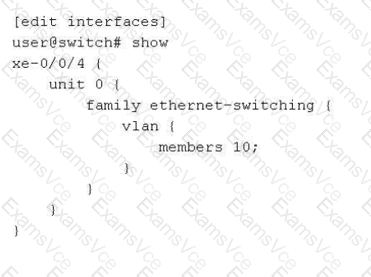
In Junos OS for switching platforms, an interface is configured for Layer 2 bridging under thefamily ethernet-switchinghierarchy. The way an interface handles VLAN traffic depends on its port mode:accessortrunk.
According to Juniper Networks technical documentation, when an interface is configured simply with members , it defaults to anaccess port. In an access port configuration:
The port is a member of only a single VLAN.
The portreceives and sends untagged traffic (Option C). Any untagged frame arriving at this interface is implicitly associated with the configured VLAN member.
The interface does not expect or process 802.1Q tags in incoming frames.
In the exhibit, interface xe-0/0/4 has members 10;. In Junos, the members statement can reference either aVLAN nameor aVLAN ID. However, when the configuration is shown as members 10; without further context of the specific ID mapping, the most precise interpretation of the CLI output provided is thatthe interface is a member of the VLAN named 10 (Option D). While "10" could be the numerical ID, Junos primarily maps members by their defined administrative name.
Why other options are incorrect:
Option A:Access ports do not receive tagged traffic; only trunk ports (which require the port-mode trunk and vlan members [ ... ] statements) are designed to process tagged frames.
Option B:While the VLAN named 10likelyhas a VLAN ID of 10, the exhibit does not explicitly confirm the ID mapping. In Junos, a VLAN named "10" could technically have a different tag ID (e.g., VLAN "Office" with ID 10). Option D is the more accurate direct reading of the displayed member configuration.