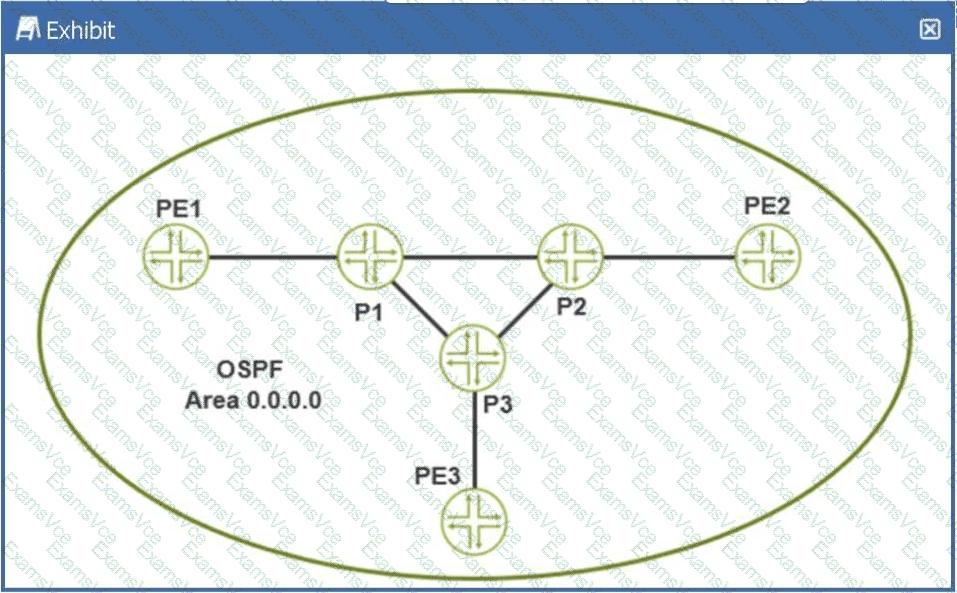
In Juniper Networks Junos OS, theLabel Distribution Protocol (LDP)is specifically designed to automate the creation of Label Switched Paths (LSPs) based on the information provided by the underlying Interior Gateway Protocol (IGP), such as OSPF or IS-IS. When LDP is enabled on a set of interfaces within an OSPF area (as shown in the exhibit with Area 0.0.0.0), it automatically discovers neighbors and exchanges label mappings for all known unicast routes in the routing table.
The defining characteristic of LDP in this context is its "topology-driven" nature. Unlike RSVP (Resource Reservation Protocol), which typically requires the manual configuration of each LSP ingress point and destination, LDP follows the IGP's shortest path tree to automatically build afull meshof LSPs between all participating routers. This means that every Provider Edge (PE) and Provider (P) router in the exhibit—PE1, PE2, PE3, P1, P2, and P3—will establish label-switched connectivity to every other router without the administrator having to define individual tunnels.
LDP accomplishes this through a downstream-unsolicited label distribution mode by default in Junos. Each router assigns a local label for its loopback address and other prefixes and advertises these to its neighbors. Because every router is performing this action for every reachable prefix in the OSPF domain, a complete fabric of label-switched paths is formed. While RSVP is more robust for traffic engineering and bandwidth reservation, LDP is the preferred protocol for creating a simple, scalable full mesh of LSPs for applications like Layer 3 VPNs or internal BGP tunneling where complex path manipulation is not required. BFD is a failure detection protocol, and BGP is used for service signaling, making LDP the only correct choice for automatic mesh creation.