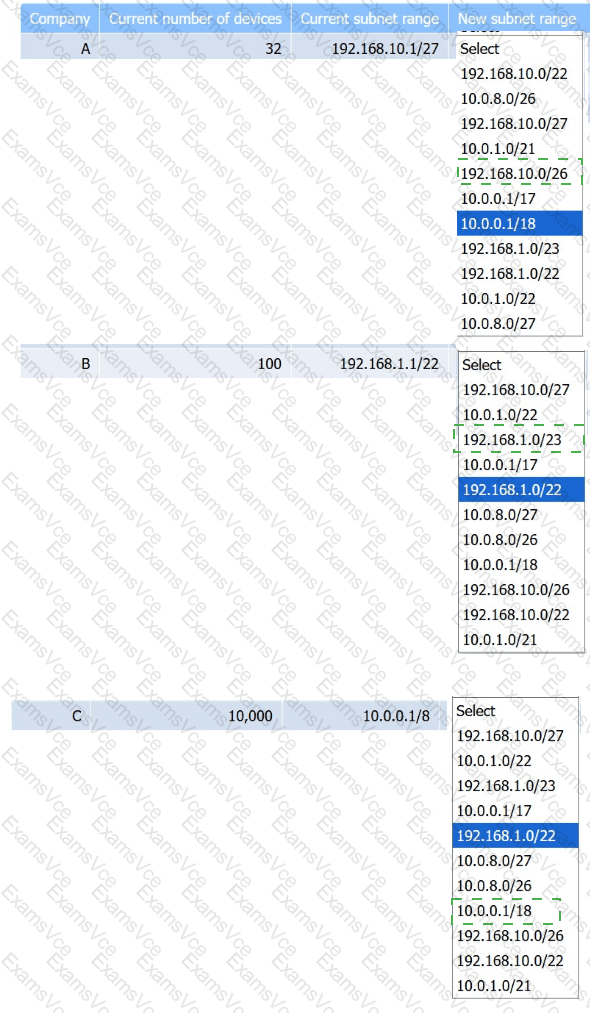
A = 192.168.10.0/26
B = 192.168.1.0/23
C = 10.0.0.1/18
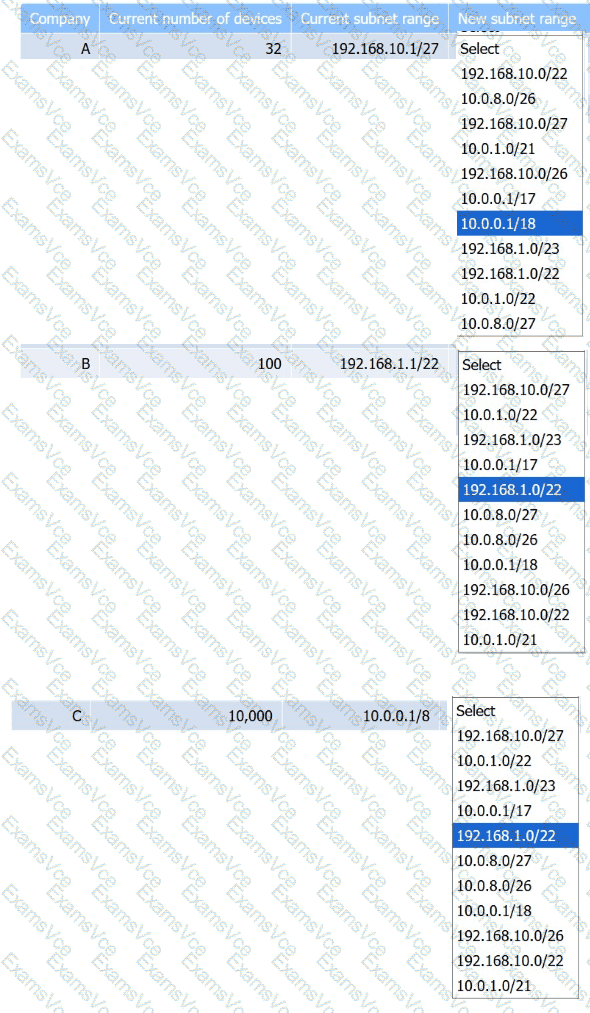
Using the choices shown in the screenshot, the best-fit subnet selections are based on host growth requirements first, then segmentation.
For Company A, the current device count is 32. With 20% growth, that becomes about 39 devices. A /27 only supports 30 usable hosts, so it is too small. A /26 supports 62 usable hosts, so 192.168.10.0/26 is the correct choice.
For Company B, the current device count is 100. With 20% growth, that becomes 120 devices. The smallest correct subnet would normally be a /25 with 126 usable hosts, but that option is not shown. From the available choices, 192.168.1.0/23 is the smallest subnet that still supports more than 120 hosts, so that is the best answer.
For Company C, the current device count is 10,000. With 20% growth, it needs space for 12,000 hosts. A /18 provides 16,382 usable hosts, while a /19 is not available and a /21 or /22 would be far too small. Therefore, 10.0.0.1/18 is the correct selection.
One important note: the dropdown choices shown do not actually let all three companies be placed into a single true Class B network block. So these answers are the best valid selections from the provided options.