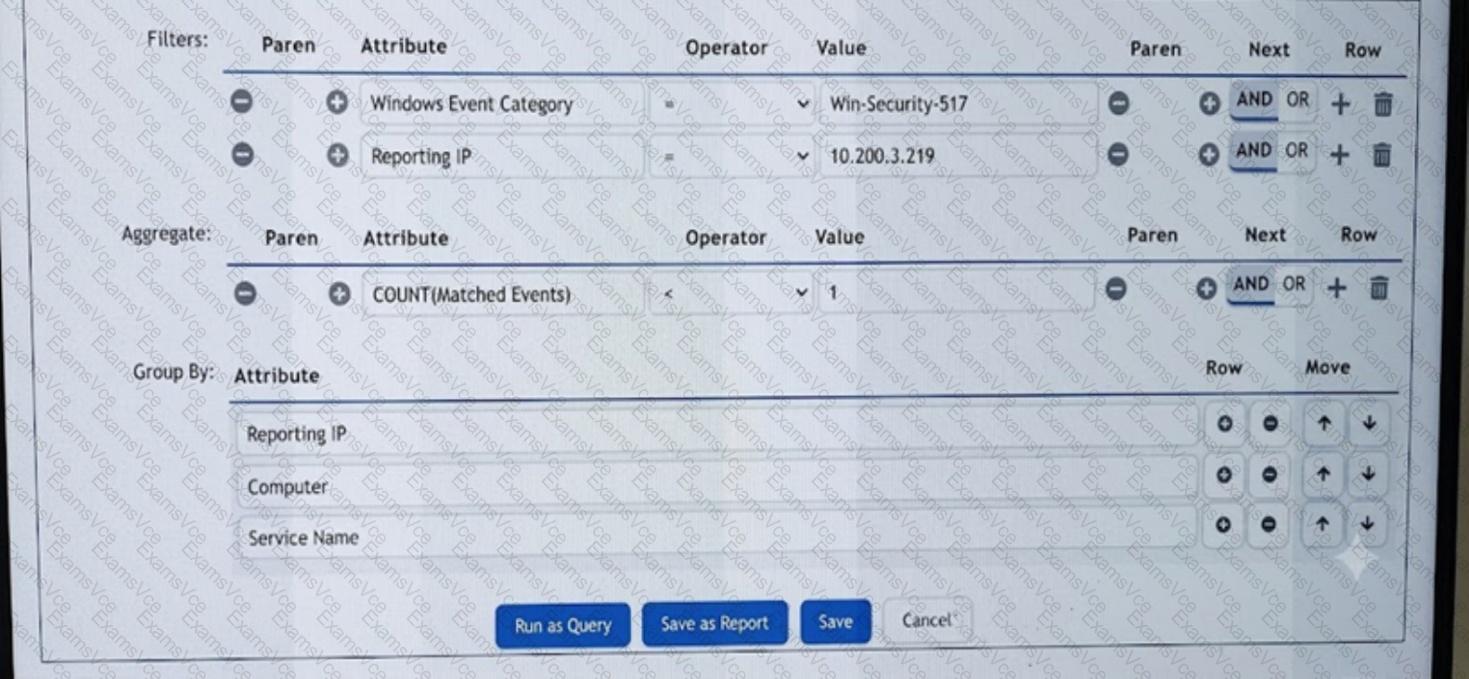
Exact Extract: “Rule subpatterns consist of a filter, aggregate, and group by condition. In the Filters section, you must specify the criteria for determining which event attributes and values the rule monitors… Next, in the Aggregate section, you must define the number of event matches required for the rule to trigger. Finally, in the Group By section, you must define which event attributes will be used to group the events before the group constraints are applied.”
Exact Extract: “FortiSIEM always sets the Aggregate condition to COUNT(Matched Events) > = 1.”
The two mistakes are B and D . In the exhibit, the aggregate condition is configured as COUNT(Matched Events) < 1 , which is logically wrong for an incident rule that should trigger when a matching event occurs. It should be COUNT(Matched Events) > = 1 or another positive threshold, depending on the detection objective. The second problem is that the filter uses Windows Event Category = Win-Security-517 instead of defining the mandatory Event Type condition. FortiSIEM rules should match the normalized event type, such as Event Type = Win-Security-517 , because Event Type identifies the parsed event FortiSIEM is correlating. The Group By fields—Reporting IP, Computer, and Service Name—do not conflict; they define how matching events are grouped. The time window is normally configured at the rule condition level, not necessarily inside this subpattern edit view, so A is not the best answer.
Technical Deep Dive: FortiSIEM correlation logic works in three layers: the Filter selects candidate events, the Aggregate decides whether enough matching events exist, and Group By controls per-entity correlation. Here, using < 1 means the rule is effectively looking for zero matching events, which is not how a Windows service-event detection should be triggered. Also, Windows Event Category is not the normalized FortiSIEM event identity; Event Type is the key normalized field used for rule accuracy. This is SIEM correlation logic only; FortiGate NP/CP offloading is irrelevant because no packet-forwarding or ASIC inspection path is involved.