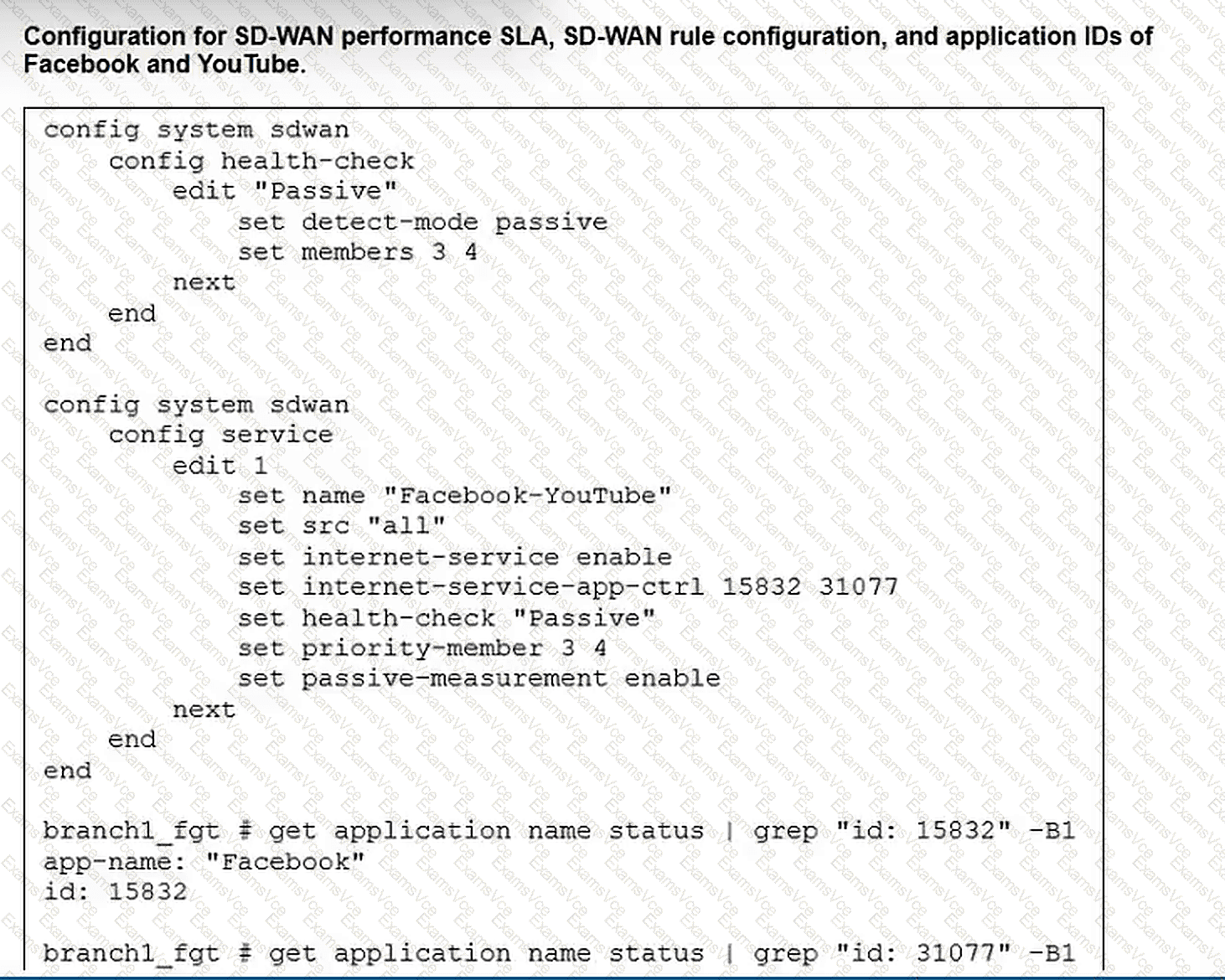
The exhibit configures an SD-WAN health check named Passive and associates it with members 3 and 4. The SD-WAN service rule identifies Facebook and YouTube using their application IDs and enables passive measurement.
Option B is correct because FortiOS calculates application-specific performance metrics from the relevant application traffic traversing each SD-WAN member.
When multiple applications are associated with a passive measurement rule, FortiGate derives the rule ' s SLA metrics from the measured performance of those applications. The resulting values can represent the average of the available application-specific measurements.
Option C is correct because passive WAN health measurement relies on information obtained from relevant TCP sessions. FortiGate analyzes TCP behavior to derive measurements such as latency, jitter, and packet loss without generating dedicated active probe traffic.
Option A is incorrect because encrypted application traffic is not categorically excluded. Passive performance measurement can use observable TCP session information without requiring access to encrypted application payloads.
Option D is incorrect because the absence of Facebook or YouTube sessions does not automatically establish that the underlying WAN member has failed. Passive monitoring requires suitable live traffic to obtain performance measurements.
In contrast, active monitoring uses dedicated probes, while prefer-passive monitoring can fall back to active probes when suitable traffic is unavailable.
[References: FortiOS 7.6 Administration Guide — Passive WAN Health Measurement; Passive Health-Check Measurement by Internet Service and Application., ==========, ]