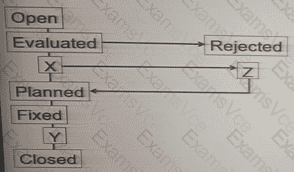
According to theISTQB Certified Tester Advanced Level – Test Manager v3.0 syllabus (Chapter 2: Test Management in the Organization), thedefect management processdefines how defects are handled from discovery to closure, ensuring traceability and communication between testing and development.
“The defect management process defines the states a defect may have during its lifetime, including identification, evaluation, correction, re-testing (confirmation testing), and closure.”
(ISTQB CTAL-TM v3.0 Syllabus, Chapter 2 – Defect Management Process)
In the standard ISTQB defect workflow:
Afterevaluation, a defect can either be:
Rejected(e.g., not a defect, duplicate, or out of scope), or
Accepted(X) — meaning it is confirmed as a valid defect and will be corrected.
Once accepted, the defect isplannedfor correction andfixedby development.
After being fixed, it must betested (Y)— also referred to asconfirmation testingorretesting.
Some evaluated defects may bedeferred (Z)— postponed for future releases.
Thus, the correct states are:
X = Accepted(defect confirmed as valid and correction planned)
Y = Tested(confirmation testing after the fix)
Z = Deferred(postponed correction)
This sequence aligns directly with the ISTQB-defineddefect management lifecycle, which includes transitions betweenopen,evaluated,accepted (planned/fixed/tested), andclosed, as well as possiblerejectedordeferredbranches.
References (from ISTQB Certified Tester Advanced Level – Test Manager v3.0 Syllabus):
Chapter 2: Test Management in the Organization
Section:Defect Management Process
Describes thedefect states, includingopen, evaluated, accepted, planned, fixed, tested (retested), closed, and alternate states such asrejectedordeferred.