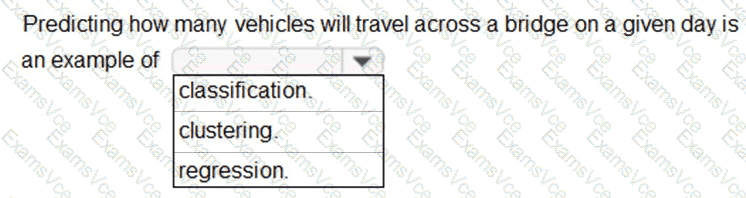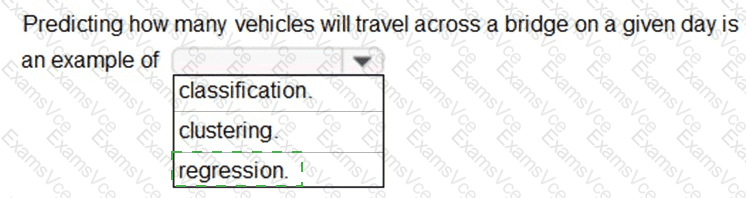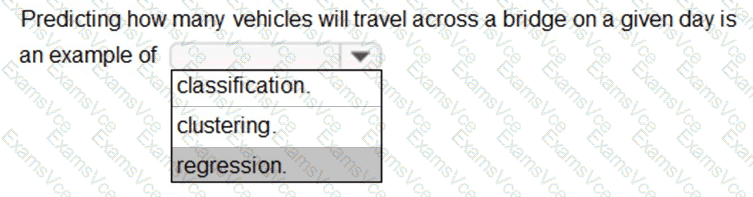
In the context of Microsoft Azure AI Fundamentals (AI-900) and general machine learning principles, regression refers to a type of supervised learning used to predict continuous numerical values based on historical data. The goal of regression is to model the relationship between input variables (features) and a continuous output variable (target).
In this scenario, the task is to predict how many vehicles will travel across a bridge on a given day. The number of vehicles is a numerical value that can vary continuously depending on factors such as time of day, weather, weekday/weekend, or traffic trends. Because the output is numeric and not categorical, this problem type clearly fits into regression analysis.
Microsoft’s official learning content for AI-900, under “Identify features of regression and classification machine learning models,” specifies that regression models are used to predict values such as sales forecasts, demand estimation, temperature prediction, or traffic volume—all of which share the same underlying objective: predicting a quantity.
To clarify other options:
Classification is used when predicting categories or discrete classes, such as determining whether an email is spam or not spam, or if an image contains a cat or a dog.
Clustering is an unsupervised learning technique used to group similar data points without predefined labels (for example, grouping customers by purchasing behavior).
Since predicting the number of vehicles results in a continuous numerical output, it aligns precisely with the regression workload type described in the Microsoft AI-900 study materials.