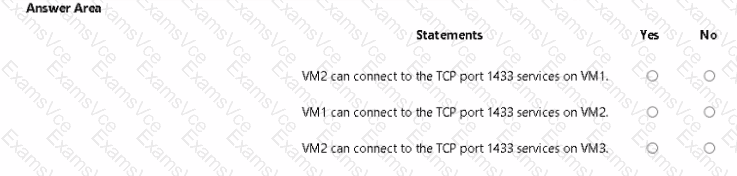
No Yes Yes
In this question, we analyze Network Security Groups (NSGs) and their effect on connectivity between virtual machines (VMs) within a virtual network (VNet). Azure NSGs contain inbound and outbound security rules that are processed in priority order (from lowest number to highest), and the first matching rule determines the outcome. NSGs can be applied at both subnet and network interface (NIC) levels.
When an NSG is associated at both levels, both must allow the traffic — if either blocks it, the traffic is denied (Microsoft Azure documentation: “Network security groups – Azure Virtual Network”).
Given Configuration Summary
Subnets
Name
Subnet
NSG
Subnet1
10.10.1.0/24
NSG1
Subnet2
10.10.2.0/24
None
VMs
VM
Subnet
IP
NSG
VM1
Subnet1
10.10.1.5
NSG2
VM2
Subnet2
10.10.2.5
None
VM3
Subnet2
10.10.2.6
None
NSG Rules
NSG1 (applied at Subnet1):
Priority
Source
Destination
Port
Action
101
10.10.2.0/24
10.10.1.0/24
TCP/1433
Allow
NSG2 (applied at VM1 NIC):
Priority
Source
Destination
Port
Action
125
10.10.2.5
10.10.1.5
TCP/1433
Block
Traffic Analysis
VM2 → VM1 (TCP 1433)
NSG1 (Subnet1) allows traffic from 10.10.2.0/24 to 10.10.1.0/24 on TCP/1433.
NSG2 (VM1 NIC) explicitly blocks traffic from 10.10.2.5 (VM2) to 10.10.1.5 on TCP/1433.
✅ Subnet-level allows, but NIC-level denies → Effective result: Denied
Answer: ❌ No
VM1 → VM2 (TCP 1433)
Outbound from VM1 → no outbound deny rule.
Inbound on VM2 → no NSG (thus allowed).
✅ No restriction applies → Traffic allowed
Answer: ✅ Yes
VM2 → VM3 (TCP 1433)
Both VMs are on Subnet2, which has no NSG applied.
No rule blocks communication within the subnet.
✅ All traffic allowed by default.
Answer: ✅ Yes
Final Verified Answers (as per Microsoft Azure Documentation):
Statement
Answer
VM2 can connect to TCP port 1433 services on VM1
❌ No
VM1 can connect to TCP port 1433 services on VM2
✅ Yes
VM2 can connect to TCP port 1433 services on VM3
✅ Yes
Supporting Extract from Microsoft Azure Documentation:
“When multiple network security groups are associated, the network interface and subnet rules are combined using a deny-by-default model. For inbound traffic to be allowed, it must be permitted by both the subnet-level and network interface-level NSGs.”
“By default, virtual network traffic within the same subnet or between subnets in the same virtual network is allowed.”
(Source: Microsoft Learn — Azure Virtual Network NSG Concepts)