Comprehensive and Detailed Explanation
HPE Press guide context | PDF page 150 | HPE Press, Aruba Certified Associate – Campus Access Official Certification Study Guide
Technical Deep Dive — Original Chat Wording
Link aggregation combines multiple compatible physical Ethernet connections into one logical interface.
This increases the total bandwidth available between connected network devices and can also improve resilience when individual member links fail.
For example, an AOS-CX switch may aggregate four 10 Gbps Ethernet interfaces into a single logical LAG.
The resulting connection provides a nominal aggregate capacity of 40 Gbps across the member links.
However, this does not mean that an individual traffic flow can automatically achieve 40 Gbps.
Traffic distribution commonly uses a hashing mechanism based on packet-header fields.
Consequently, an individual flow normally uses one selected physical member, while multiple flows can be distributed across the available members.
Dynamic link aggregation uses Link Aggregation Control Protocol (LACP) to establish and maintain the aggregation relationship.
LACP verifies compatible aggregation partners and monitors member synchronization.
A representative AOS-CX configuration is:
configure terminal
interface lag 1
lacp mode active
no shutdown
Physical interfaces must then be assigned to the LAG.
Link aggregation does not encrypt traffic or improve the electrical signal quality of individual cables.
Although LACP can help identify failed or incorrectly connected members, its primary advantage in this question is increased aggregate bandwidth.
Therefore, Option B (Increased bandwidth between devices) is correct.
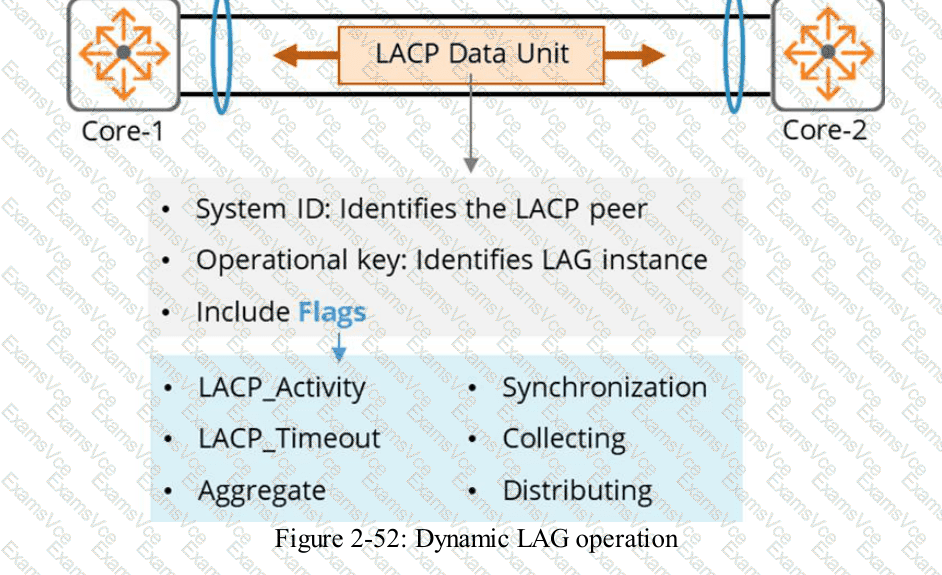
HPE Press study-guide figure / related learning illustration · Q177 Fig 2-52 Dynamic LAG



