Comprehensive and Detailed Explanation
HPE Press guide context | PDF page 667 | HPE Press, Aruba Certified Associate – Campus Access Official Certification Study Guide
Technical Deep Dive — Original Chat Wording
A high-level network design describes the overall architecture required to satisfy an organization's business and technical objectives.
It identifies major infrastructure components, network locations, logical segmentation, connectivity requirements, and important architectural dependencies.
Location and building information are essential because physical geography directly affects network topology and infrastructure planning.
For example, an organization may operate three office buildings connected through a campus distribution network.
The high-level design should identify these buildings, their general locations, and their connectivity relationships.
This information helps determine where access, aggregation, and core infrastructure should be positioned.
It also supports decisions involving inter-building fiber connections, network redundancy, wireless deployment, and management boundaries.
Detailed room coordinates and individual floor-plan measurements are normally developed during more detailed site surveys and low-level design activities.
Site-access requirements are also important, particularly for implementation planning, but the question asks for the broad physical information required to interpret the architecture.
A building's postal address may be useful, but it does not independently describe the building's role or relationship within the campus network.
The high-level design therefore needs a broader description of locations and buildings, rather than only mailing addresses or precise individual-room coordinates.
Therefore, Option C (Location and building information) is correct.
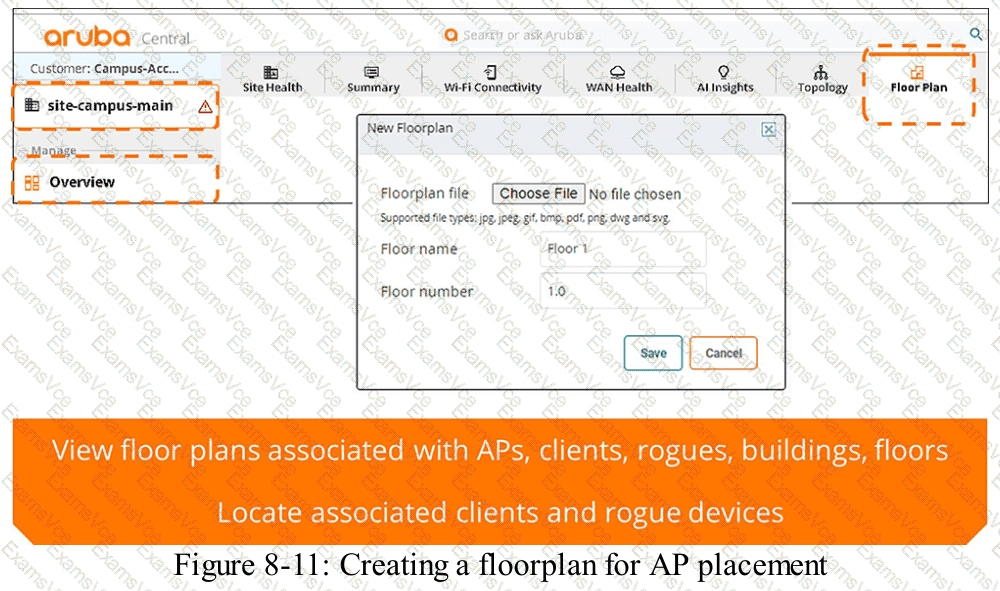
HPE Press study-guide figure / related learning illustration · Q194 Fig 8-11 floorplan



