Comprehensive and Detailed Explanation
HPE Press guide context | PDF page 241 | HPE Press, Aruba Certified Associate – Campus Access Official Certification Study Guide
Technical Deep Dive — Reconstructed (Original Chat Text Not Recoverable)
OSPF interfaces intended to become neighbors must operate in the same OSPF area and have compatible parameters. Process identifiers are local, router IDs must be unique, and loopback assignments need not match. The configured area determines the link-state database relationship and route exchange boundary.
The selected answer corresponds to B: OSPF area. This matches the mechanism or management behavior described in the scenario rather than merely a related network feature.
Operational workflows should preserve consistent inventory, authorization, configuration history, and monitoring so that administrators can locate and manage devices predictably.
The operational view should be interpreted together with its underlying records: an alert, subscription count, or device status may describe management state rather than physical availability.
The practical deployment consequence is important: a plausible configuration can still fail when the peer interface, device role, licensing scope, or physical medium is mismatched. Checking that surrounding dependency avoids a misleading diagnosis.
When troubleshooting or designing a change, verify compatibility between all participating devices, the management scope, and the applicable software release. The most useful evidence is the state observed on both sides of the affected connection.
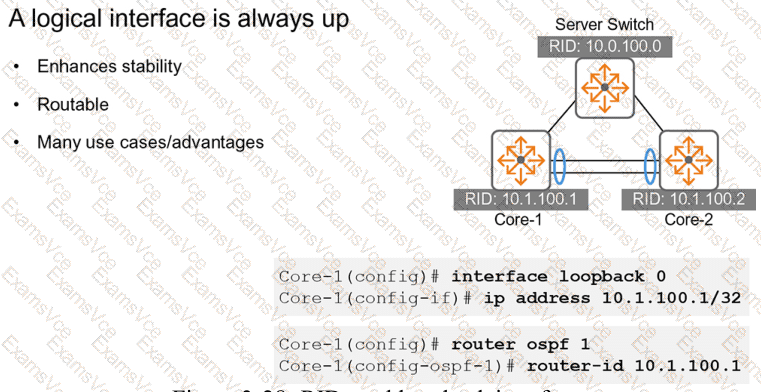
HPE Press study-guide figure / related learning illustration · Fig 3-28 loopback



