Comprehensive and Detailed Explanation
HPE Press guide context | PDF page 124 | HPE Press, Aruba Certified Associate – Campus Access Official Certification Study Guide
Technical Deep Dive — Original Chat Wording
IEEE 802.1Q VLAN tagging allows multiple logically separated networks to share the same physical Ethernet connection.
This capability is essential in multi-story buildings where access switches serving different floors connect to distribution switches through a limited number of uplink cables.
An Ethernet trunk carries frames belonging to several VLANs. VLAN tags identify the originating broadcast domain so that receiving switches can forward traffic appropriately.
For example, VLAN 10 may carry employee traffic, VLAN 20 may carry guest traffic, and VLAN 30 may carry surveillance traffic.
Instead of deploying three separate uplinks, a single appropriately sized trunk can transport all three VLANs.
On an AOS-CX switch, a representative configuration is:
configure terminal
interface 1/1/49
no routing
vlan trunk native 1
vlan trunk allowed 10,20,30
no shutdown
The connected switch must have compatible VLAN and trunk configuration.
Most traffic on a standard 802.1Q trunk is tagged, while native-VLAN handling follows the configured trunk mode.
Access ports ordinarily associate untagged endpoint traffic with one VLAN and are not intended to transport multiple independently tagged endpoint VLANs.
Therefore, Option B is correct.
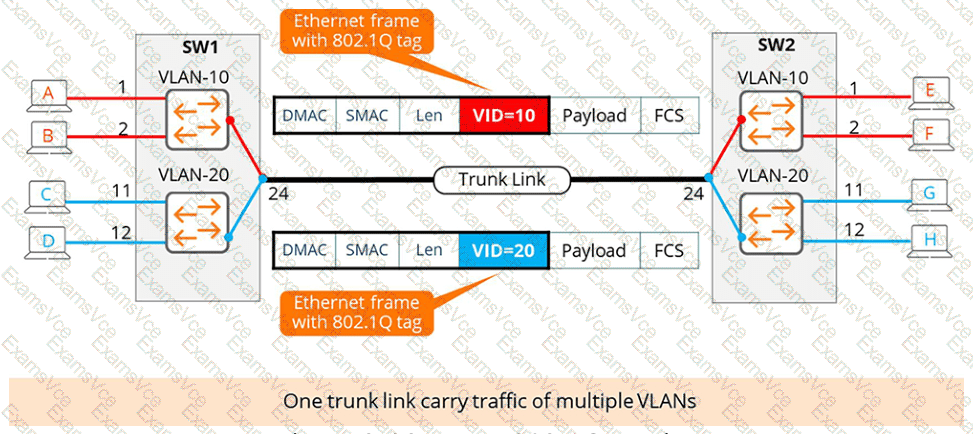
HPE Press study-guide figure / related learning illustration · Q136 Fig 2-32 8021Q



