Comprehensive and Detailed Explanation
HPE Press guide context | PDF page 42 | HPE Press, Aruba Certified Associate – Campus Access Official Certification Study Guide
Technical Deep Dive — Original Chat Wording
Copper Ethernet cabling provides a practical method for connecting network equipment over short distances.
Category 6a (Cat 6a) is designed to support high-speed Ethernet transmission with improved performance against interference and crosstalk.
It supports 10GBASE-T connectivity over standard structured cabling distances up to 100 meters when compatible network interfaces and properly installed cabling are used.
For devices located in the same equipment rack, a short Cat 6a patch cable can provide reliable Ethernet connectivity.
Examples include connections between compatible switches, routers, firewalls, and management devices.
The chosen cable must match the physical Ethernet interfaces of the connected equipment.
For example, a Cat 6a cable is appropriate when both devices use compatible RJ-45 Ethernet ports.
A power cord carries electrical power and is not an Ethernet data cable.
Single-mode and multimode fiber are optical transmission media rather than copper cables.
Fiber connections require compatible optical interfaces and transceivers.
One additional consideration is that Direct Attach Copper (DAC) is often a cost-effective choice for very short, high-speed connections between devices with compatible SFP, SFP+, or QSFP interfaces.
However, DAC is not included among the available options.
Of the four listed choices, only Cat 6a is a suitable copper Ethernet data cable.
Therefore, Option A (CAT6a Ethernet patch cable) is correct.
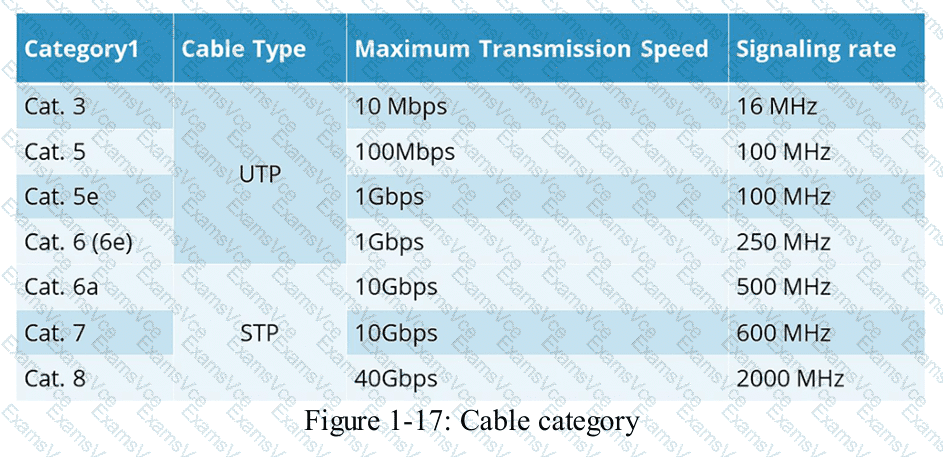
HPE Press study-guide figure / related learning illustration · Q132 Fig 1-17 Cable Cat



